
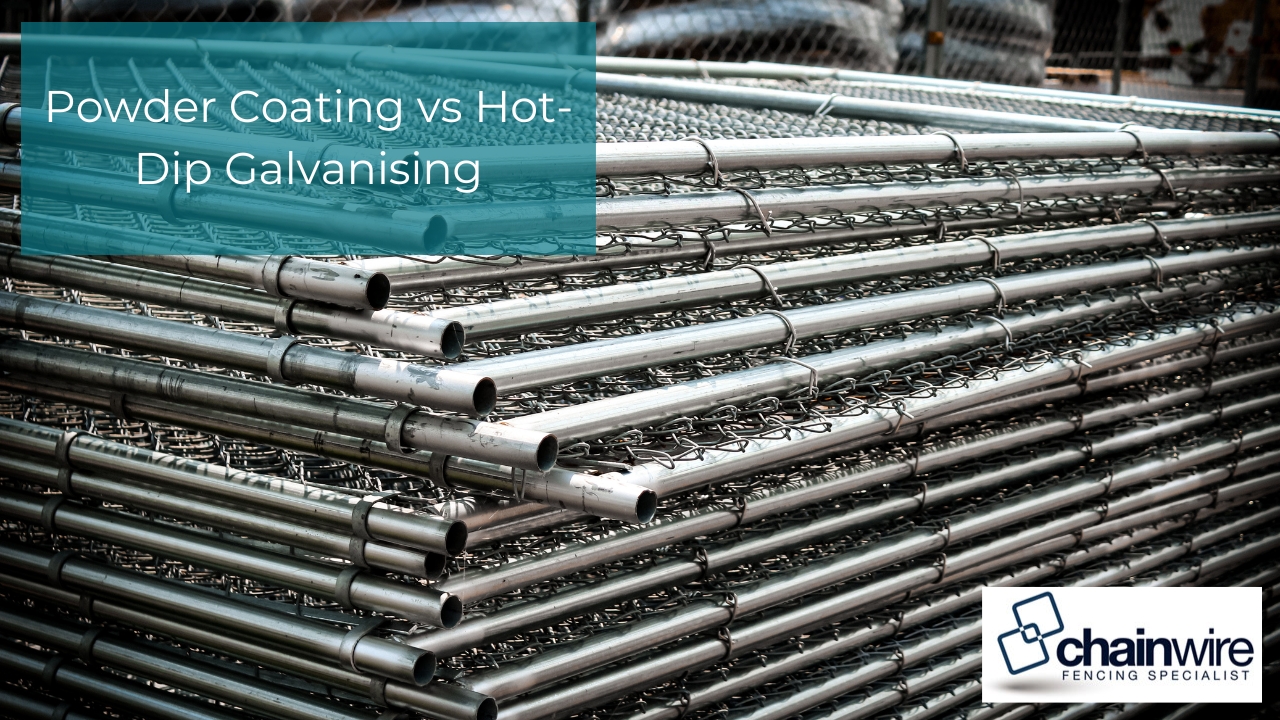
Which Finish Lasts Longer on Fabricated Steel?
When you are specifying fabricated steel fencing for a commercial or industrial site, the finish is not an afterthought. It determines how long the steel lasts, how much maintenance it will need, and whether it is still performing in 10 years or starting to show rust at the welds.
Powder coating and hot-dip galvanising are the two most common protective finishes applied to steel fencing components. They work differently, suit different conditions, and have different cost and lifespan profiles. Here is what you need to know before deciding which one to specify.
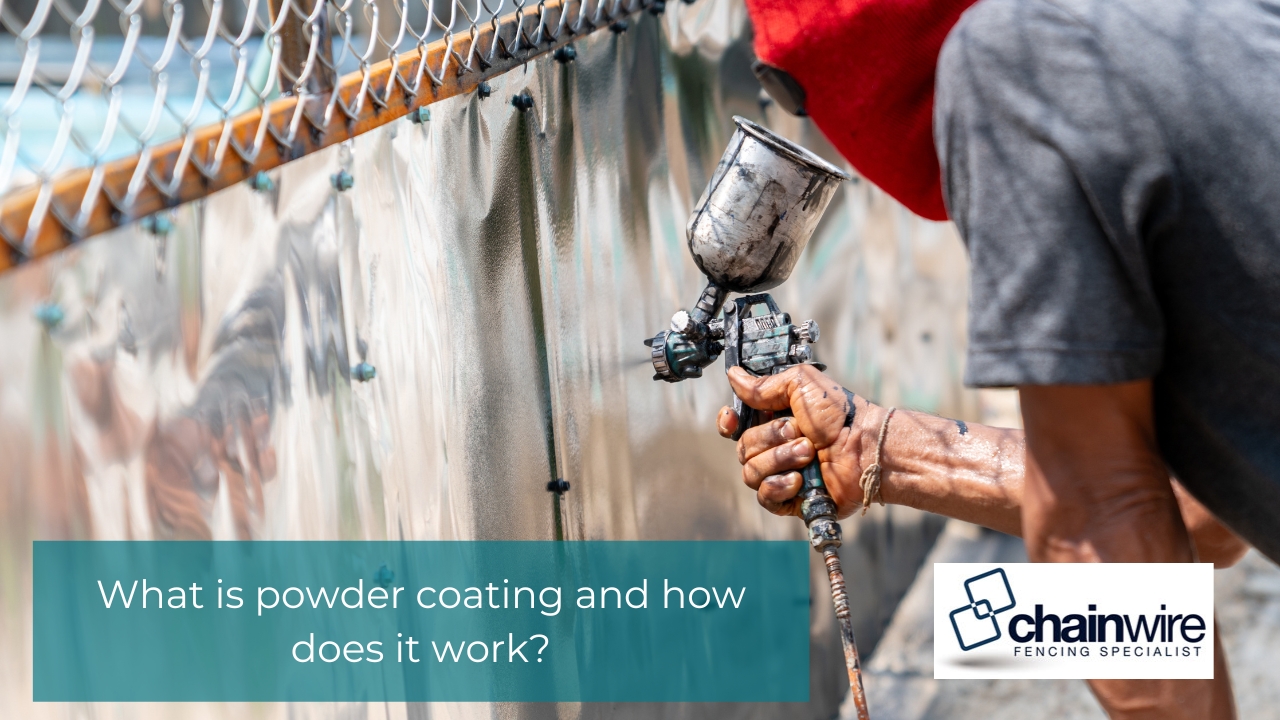
What is powder coating and how does it work?
Powder coating is a dry finishing process. Finely ground pigment and resin particles are electrostatically charged and sprayed onto the steel surface, where they adhere before the component is transferred to an oven and cured at around 180 to 200 degrees Celsius. The heat causes the powder to flow and bond into a hard, smooth film across the surface.
The result is a consistent, even coating that is more durable than standard paint and available in any RAL colour. For projects where the fencing needs to match a building facade, a school’s colour scheme, or a client’s corporate specification, powder coating is the standard solution.
The coating sits on top of the steel surface. It does not penetrate the metal. This means that any breach in the coating, whether from impact, abrasion, or a scratch at a cut edge or weld point, exposes bare steel directly to the environment. In humid or coastal conditions, rust can begin at those breach points and spread laterally under the surrounding coating.
Under normal conditions, a quality powder coat finish on steel fencing typically lasts 10 to 15 years before it requires attention.
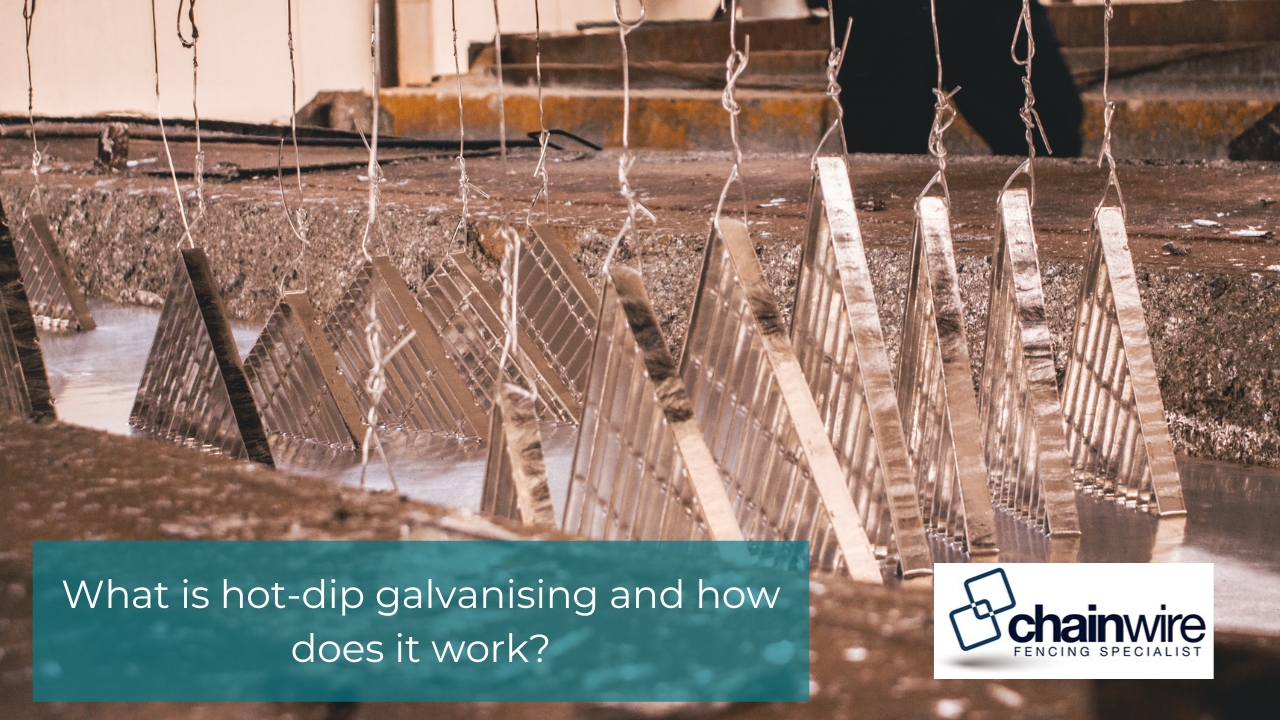
What is hot-dip galvanising and how does it work?
Hot-dip galvanising is a metallurgical process. The fabricated steel component is cleaned, fluxed, and immersed in a bath of molten zinc at around 450 degrees Celsius. The zinc reacts with the steel surface to form a series of zinc-iron alloy layers, topped by an outer layer of pure zinc.
The key difference from powder coating is that the zinc layer is bonded to the steel at a molecular level, not applied on top of it. The protection is integral to the component, not a surface film that can be breached.
Galvanising also provides cathodic protection. Even if the zinc surface is scratched through to bare steel, the surrounding zinc preferentially corrodes to protect the exposed steel underneath. This self-sacrificing property is why galvanised steel performs so well in harsh outdoor environments over decades rather than years.
The practical limitation is colour. Hot-dip galvanising produces the characteristic silver-grey finish that most people associate with Chainwire fencing and industrial steelwork. It cannot be specified in other colours without a secondary powder-coat application on top.
Comparing durability: how long does each finish last?
In a standard suburban environment with moderate exposure, a quality powder coat finish will typically last 10 to 15 years on fabricated steel fencing before it begins to show chalking, fading, or corrosion at vulnerable points such as cut edges and welds.
Hot-dip galvanising in the same environment will typically last 20 to 50 years before significant maintenance is needed. In rural and inland industrial environments with lower humidity and minimal salt exposure, galvanised steel fencing can perform for the full service life of the structure without any surface treatment intervention.
The gap narrows in coastal environments where salt air accelerates zinc consumption. Even so, galvanising outperforms powder coating in these conditions. The zinc layer is consumed gradually rather than breached suddenly, and the cathodic protection mechanism continues to function as long as zinc remains.
The highest-performing option is to combine both. Galvanise the steel first for corrosion protection, then apply powder coat over the galvanised surface for colour, additional UV resistance, and a second barrier against environmental exposure. This duplex system is common on high-value or long-service installations and can extend overall service life well beyond either finish used alone.
Which finish suits the Hunter Valley and Newcastle environment?
Newcastle and the surrounding region presents two distinct environments for steel fencing.
Coastal and harbour-adjacent sites, including properties near Newcastle Harbour, the Lake Macquarie foreshore, and the eastern suburbs from Stockton through to Swansea, are in a genuinely corrosive environment. Salt-laden air accelerates zinc consumption on galvanised steel and causes powder coat to fail earlier at any unprotected edge or join. For these locations, galvanising is the minimum recommended finish for structural steel fencing components. The duplex system is the better specification for gates, post bases, and any weld-heavy fabricated components where surface integrity is critical.
Inland Hunter Valley sites, including construction compounds, logistics facilities, mining support operations, and agricultural properties, face less salt exposure. Humidity through the valley can be significant in summer, but the corrosion rate on galvanised steel in these conditions is considerably lower than at the coast. For inland industrial sites, either finish is appropriate depending on the aesthetic requirements and maintenance budget.
For Chainwire fencing specifically, galvanising is the standard finish across both environments. The open mesh structure of chainwire fencing means every wire strand is exposed to the weather on all sides. A surface-only coating like powder coat would be impractical to apply uniformly and quick to fail at wire intersections. Hot-dip galvanising coats the entire wire surface including the twisted joins, which is why galvanised Chainwire remains effective for decades in the field.
Cost comparison: powder coating vs galvanising
On a per-component basis, hot-dip galvanising is generally the lower upfront cost option for structural steel sections. The process is well-established and the cost scales well with component size and quantity.
Powder coating costs vary depending on the colour specified and the complexity of the component geometry. Simple flat panels and straight sections are straightforward to coat. Fabricated gate frames with multiple welds, mitred corners, and hollow sections require more preparation and care to achieve a consistent finish, which adds time and cost.
The more relevant cost comparison is over the service life of the fence. A galvanised perimeter fence that requires no maintenance for 30 years costs considerably less over that period than a powder-coated fence that needs touch-up coating at year 12 and a full recoat at year 18, particularly if the fence run is long or difficult to access.
For budget-sensitive projects where aesthetics are a priority and the environment is not particularly harsh, powder coating makes sense. For infrastructure, industrial, and long-hold commercial installations where ongoing maintenance cost matters, galvanising delivers better value over time.
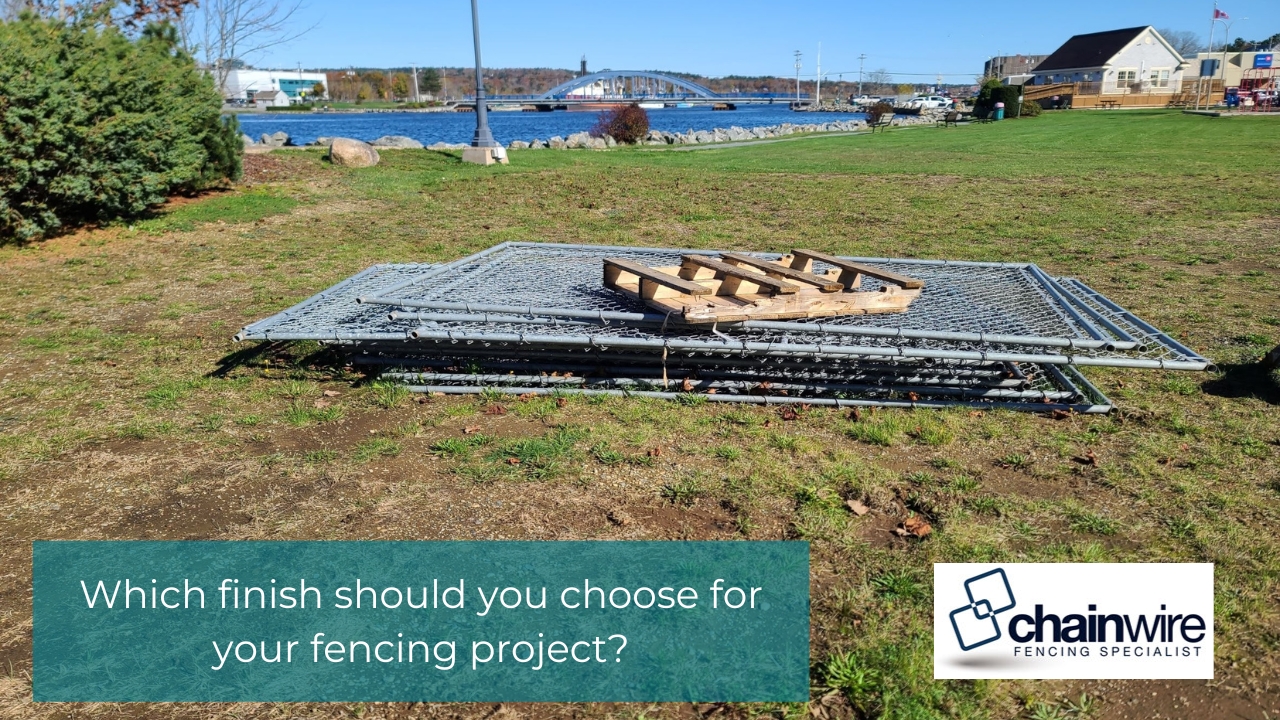
Which finish should you choose for your fencing project?
If the site is coastal or high humidity, specify galvanising as the minimum for all structural steel components. Add powder coat over the galvanised finish if colour or appearance is a requirement.
If the site is inland with moderate exposure and aesthetics matter, such as a school perimeter, a commercial frontage, or a residential development, powder coating is appropriate. Use a quality formulation and ensure cut edges and welds are properly sealed during fabrication to maximise the coating’s service life.
If the installation needs to last as long as possible with the least amount of intervention, use the duplex system. Galvanise first, then powder coat. The upfront cost is higher, but for a fence that will be difficult to maintain or expensive to replace, it is the right specification.
Chainwire Fencing Specialist handles steel fabrication and finish specification for commercial and industrial fencing projects across Newcastle and the Hunter Valley. Contact us for a free quote and we can advise on the right finish for your site conditions and project requirements.