
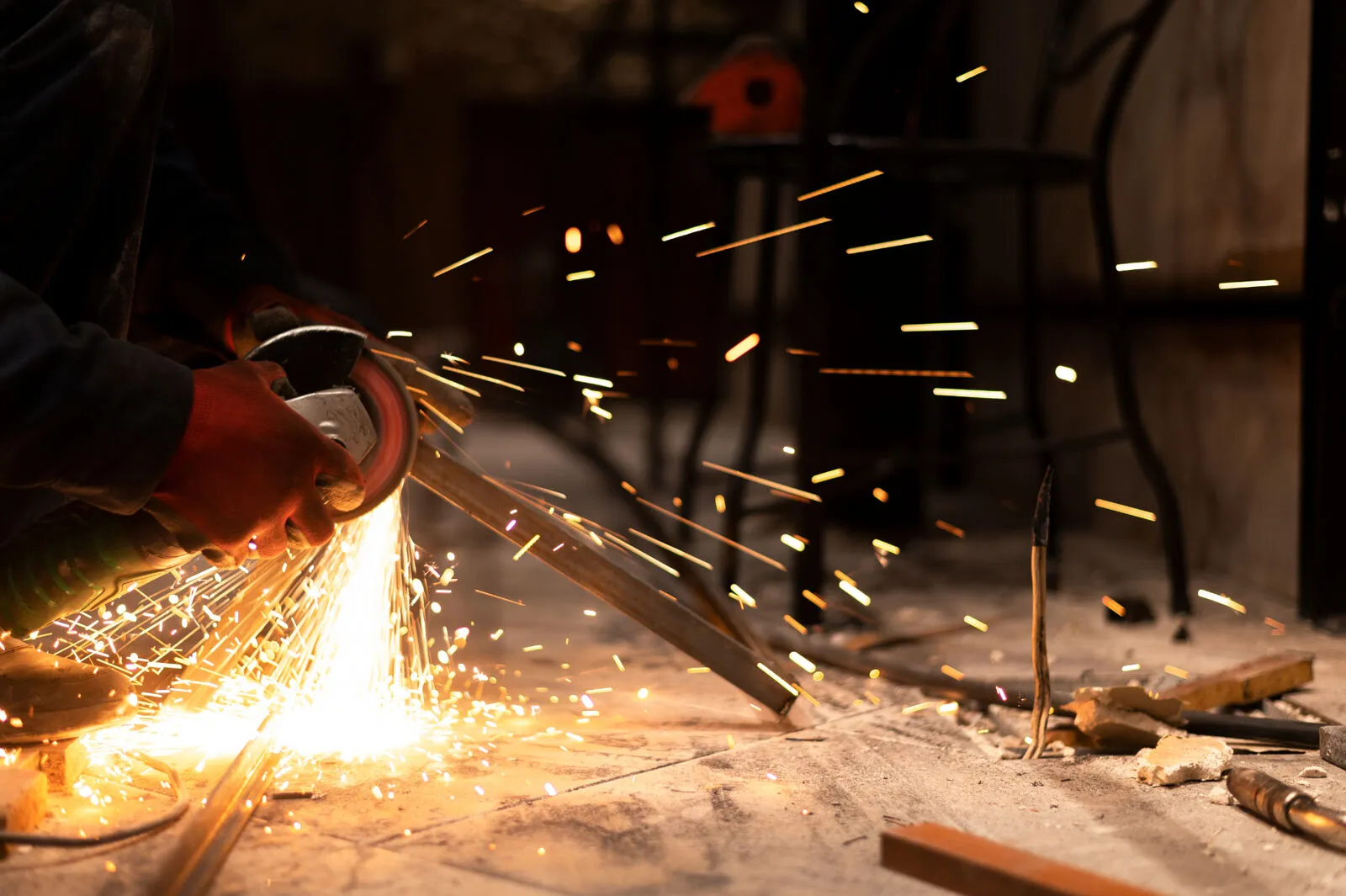
When a commercial or industrial site needs fencing, the default is often to order from a catalogue: standard panels, standard posts, standard heights. For a suburban boundary that works fine. For a site with uneven ground, non-standard access points, heavy vehicle movement or specific security requirements, it usually falls short. That is where custom steel fabrication comes in, and it is the part most fencing companies subcontract out. We do it ourselves.
What fabrication involves
Fabrication is the process of turning raw steel into a finished component built to a specific design. Rather than picking a product that already exists, it starts with a specification and works backwards from it. That spec might come from an engineer, a site manager, an architect, or simply from the physical requirements of the job: a gate that has to span an irregular opening, a mesh panel that must fit a non-standard height, a perimeter frame with particular load-bearing requirements. The result is a component that fits the application precisely and does not rely on workarounds during installation.
Cut, bend, weld
Most fabrication comes down to three processes, applied in sequence.
Cutting
Steel is cut to length and shape before anything else, using circular saws, flame cutters or plasma cutters. Plasma cutting is common for precise profile work because it gives clean edges with minimal distortion on thinner sections. We feed cut dimensions to the machinery from design software, which keeps repeat components accurate.
Bending
Where a component needs to follow a curve, angle or arch, the cut steel goes through bending rollers or a press brake. This is how curved gate frames, arched top rails and angled structural elements are formed. The degree of bend matters, because over-bending weakens the material at the bend point, and knowing the tolerance for each grade and section is part of the trade.
Welding
Welding joins the parts into a finished structure, and it is the stage that decides how well the result handles load, stress, vibration and long-term wear. On a commercial or industrial gate frame or perimeter post, weld quality is not cosmetic. A poor weld fails under exactly the conditions the structure was installed to handle.
What we build in steel
- Beams and columns for commercial and residential structures
- Bar joists and metal trussing
- Platforms for workshops or construction
- Grates and access structures
- Gate frames for large openings
Why off-the-shelf fencing fails demanding sites
Standard fencing is made in fixed dimensions for the broadest market. That is economical, but it is not built to solve a specific problem. Consider a logistics yard with an entry widened for B-double trucks: a standard sliding gate will not span it, but a fabricated gate can be built to whatever width and structural weight the job needs. Or a construction compound on a Hunter Valley slope where the ground drops 600mm across the run: standard panels leave gaps at the base or get shimmed in ways that compromise the line, while panels built to the actual site levels sit right. There is also finish. Standard fencing comes in whatever powder-coat colours the manufacturer offers, whereas a fabricated component can be finished in any colour or galvanised to a specific grade to match existing infrastructure.
Where custom steel earns its place
- Gate frames for large openings, swing or sliding, built to any span with commercial hinges, automation and locking specified to the site.
- Industrial perimeter fencing on mining, logistics and port sites, with specific height, mesh grade and anti-climb requirements, prefabricated in sections to suit installation conditions.
- Access structures including pedestrian barriers, stairwell guards, platform railings and bollard systems.
- Structural components such as custom post bases, anchor brackets, tension wire assemblies and frame supports for adapting a standard system to a non-standard site.
Choosing a fabricator
Not every business that does fencing does fabrication, and not every fabrication shop understands fencing. For commercial and industrial work the two disciplines need to overlap. Relevant project experience matters more than general capability claims: a company that has fabricated gates and perimeter structures for demanding sites understands the standards, the documentation and the site safety that come with them. It helps to have one contractor handle the full process, from steel selection through fabrication to the applied finish, so there is a single point of accountability for the result.
That is the way we are set up. We source steel from reputable suppliers, fabricate in our Toronto workshop, and install the finished job, so the fence, the gate and the steelwork all come from the one crew rather than three. No job is too complex, and it is worth telling us the actual site conditions up front, because that is what the fabrication is built around.