
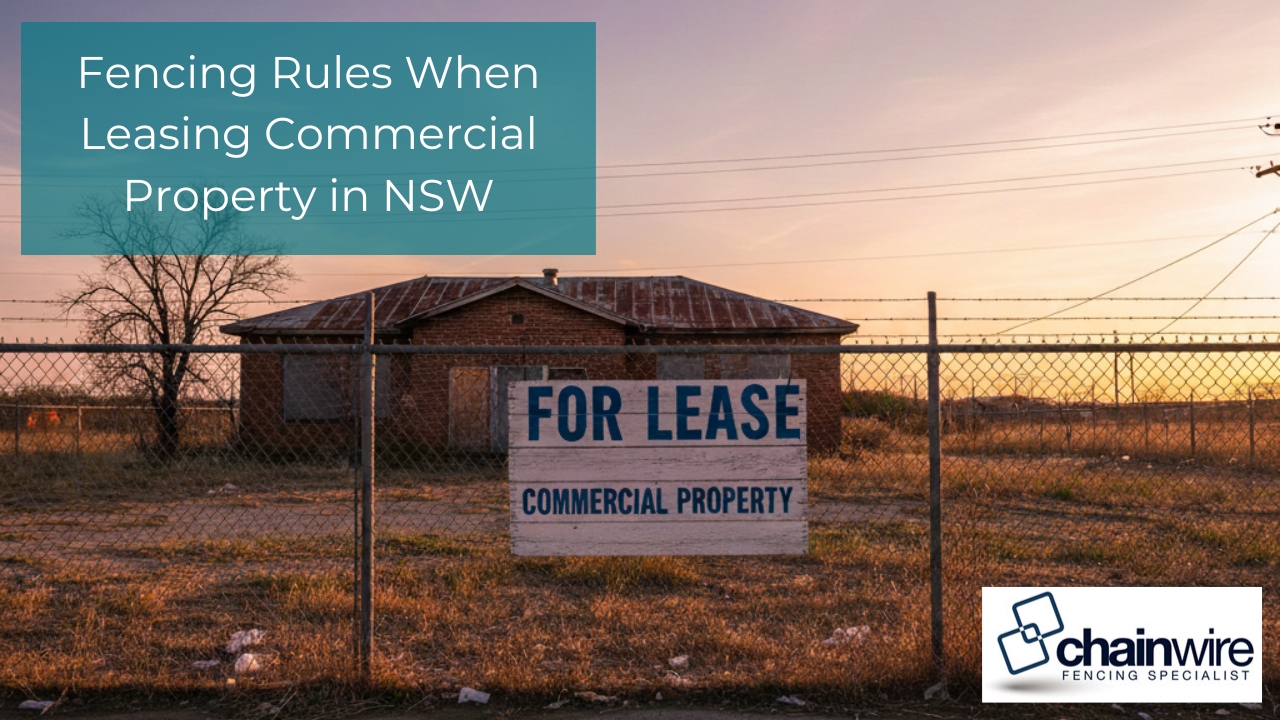
Leasing a warehouse, yard or commercial site in NSW usually comes with one awkward question early in the tenancy agreement. Can we put a fence up?
Sometimes it is for security. Sometimes it is to keep stock or vehicles contained. Sometimes it is simply because the neighbouring business keeps accidentally using your driveway.
Either way, fencing on a leased property is not just a get the tradie in and bang it up job. In NSW you need to think about lease permissions, planning rules, boundaries and who owns them, plus a few safety basics that councils and certifiers care about.
1. Start with your lease before you price a fence
In most commercial leases, fencing counts as an alteration or improvement to the premises. That usually means:
- you need the landlord’s written consent
- the landlord might want the fence done by a licensed contractor, to a certain standard
- the lease may say you have to remove it at the end, also called make-good, even if you paid for it.
Retail shop leases can have extra rules under the Retail Leases Act 1994 NSW, but plenty of industrial and commercial leases are mainly whatever the contract says, so it is worth reading those clauses carefully.
Tip: If the fence is important to how you will run the site, security, compliance, stock control, get it agreed in writing before you sign.
2. NSW planning rules, is your fence exempt, complying, or DA
In NSW, a lot of fencing can be built as exempt development with no approval or complying development with a CDC through council or a private certifier, but only if you tick the right boxes under the statewide planning policy.
For commercial and industrial zones, fences done as complying development need to meet the standards in the Commercial and Industrial Alterations Code, Part 5.
When you cannot assume it is exempt
Even if your site is zoned business or industrial, the no approval path can drop away in certain situations, including:
- heritage items on the lot or along the boundary
- being along certain road boundaries or setback areas
- foreshore areas or flood-control lots, this one can catch people out on industrial land near waterways
So yes, your mate’s fence in the next suburb might have been exempt, but your site might not be.
3. The key exempt standards for business and industrial zones
If you are in a business or industrial zone and you are aiming for exempt development, NSW guidance sets some clear standards. For example:
- Fence height generally must not be higher than 3m, and 1.2m if it is masonry
- If your lot is next to a residential zone, the portion of fence above 1.8m needs to be at least 75 percent transparent
- If the fence is along a road boundary or setback area, the portion above 1.2m needs to be at least 75 percent transparent
- Gates must not open outwards
- On bushfire-prone land, fencing needs to be non-combustible or hardwood
- Barbed wire or electric fencing is not allowed as exempt development in business and industrial zones; there are limited exceptions in other zones.
This is where chain wire is often a good fit on leased sites because it naturally meets those transparent fence rules in a lot of situations.
4. Boundary fences, who is responsible when you are just the tenant
This is where it can get a bit messy or confusing. In NSW, the Dividing Fences Act 1991 is written around adjoining owners, landowners, not tenants. In plain English, the landlord is usually the one with the legal standing to deal with a true boundary fence dispute or cost sharing with the neighbour.
But your lease might push the practical cost back onto you via maintenance or outgoings clauses. That is common, and it is why you want the lease wording clear.
If the property is strata
If you are in a strata complex, fences can be common property, and that changes everything.
The owner’s corporation has a duty to maintain and repair common property under NSW strata law, and there are also specific provisions dealing with dividing fences.
Translation: you may need owners corporation approval before anything gets touched, even if you and the landlord are happy.
5. Safety and site access rules that get overlooked
A fence is not just about the fence. It affects how people and vehicles move around the site.
A few common examples we see:
- gates swinging out over a footpath or driveway, often not allowed for exempt development anyway
- fencing that blocks sight lines at a driveway exit
- poor gate placement that creates a pinch point for forklifts, delivery trucks or staff parking
- sharp edges, trip hazards, or unstable panels that become a workplace risk.
Under the NSW Work Health and Safety Act 2011, duties can apply to people who manage or control workplaces and fixtures, and multiple parties can have duties at the same time, landlord, tenant, contractors.
You do not need to turn this into a legal project. Just design the fence like people use the site, because they will.
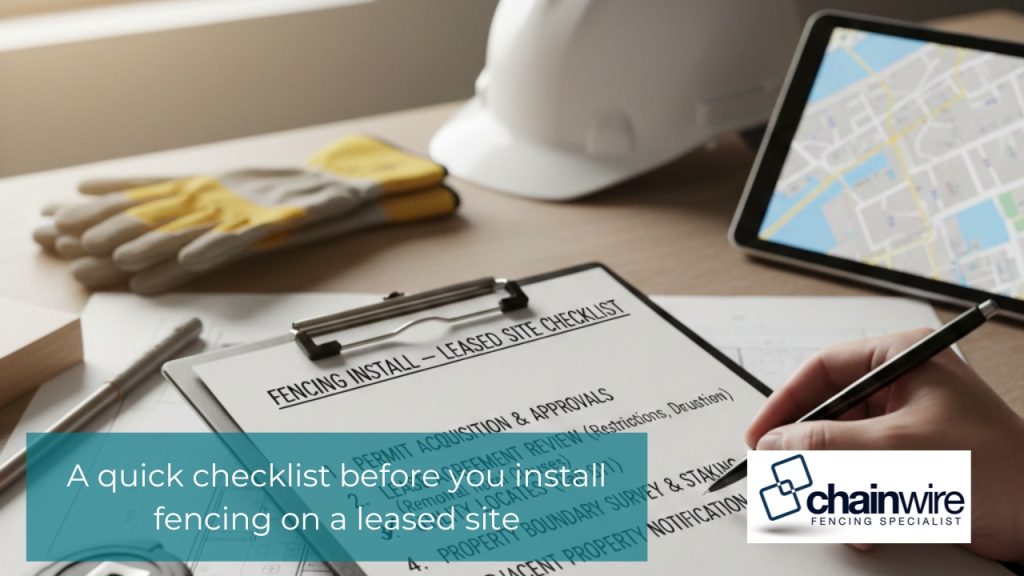
6. A quick checklist before you install fencing on a leased site
If you want to avoid the usual headaches, run through this list early:
- Lease check, do you need landlord consent, and is there a make-good clause
- Boundary check, is it a true boundary fence, internal fence, or strata or common property
- Planning check, is it exempt, complying CDC, or likely to need a DA due to height, materials, or location
- Neighbour check, will transparency rules apply, next to residential or a road boundary
- Services and easements, any underground services, drainage lines, access easements or fire trails to keep clear
- Security spec, height, mesh size, posts, gates, access control, and whether anything like barbed wire will trigger approvals.
7. Where chain wire fencing usually makes sense for leased commercial property
If you are leasing, you normally want fencing that is:
- secure, but not a planning headache
- practical for deliveries and day-to-day access
- straightforward to repair if it gets hit
- easy to modify later if the lease or site layout changes.
Chain wire is often the no drama option because it is strong, visible, and typically counts as transparent where the rules require it.
If you are weighing up options, have a look at our commercial fencing services and see what suits your site and budget.
Need help working out what you can build
Every site is a bit different, zoning, frontage roads, strata rules, flood overlays, it adds up quickly. If you tell us what you are leasing and where, we can help you map out a practical fence plan and talk you through the likely approval path.
Get a quote and we will take it from there.
Quick note: This article is general information, not legal advice. If your lease or site has tricky conditions, heritage, strata disputes, boundary arguments, it is worth getting proper advice alongside your fencing quote.