
Temporary fencing is the quick, flexible way to close off and control an area, a building site, an event, a hazard, or a boundary you have not built permanently yet. It goes up fast, comes down cleanly, and moves as the work moves. The trick is picking the right type for the job, because a crowd barrier and a site perimeter are doing very different work.
Here are the main types and where each earns its place.
Mesh panel (temporary chainwire) fencing
The most common site fence. Rigid mesh panels drop into portable concrete or rubber feet, clamp together, and stand without anything driven into the ground. That is what makes it quick to deploy and easy to relocate.
Good for: construction and demolition perimeters, closing off hazards, securing plant and materials, and anywhere you want a strong, see-through boundary that can be reconfigured. Panels take shade cloth or printed banner mesh for screening, dust control or branding. A lockable pedestrian gate and a wider vehicle gate slot straight into a run.
Chain link with driven or cemented posts
A step more permanent than panels, the posts go into the ground so the fence is steadier and harder to shift. It still reads as temporary and comes out at the end of the job, but it stands up better to wind, long runs and sites that will be fenced for months rather than weeks. It keeps debris in, keeps trespassers out, and lets water and air through.
Barricades and crowd control barriers
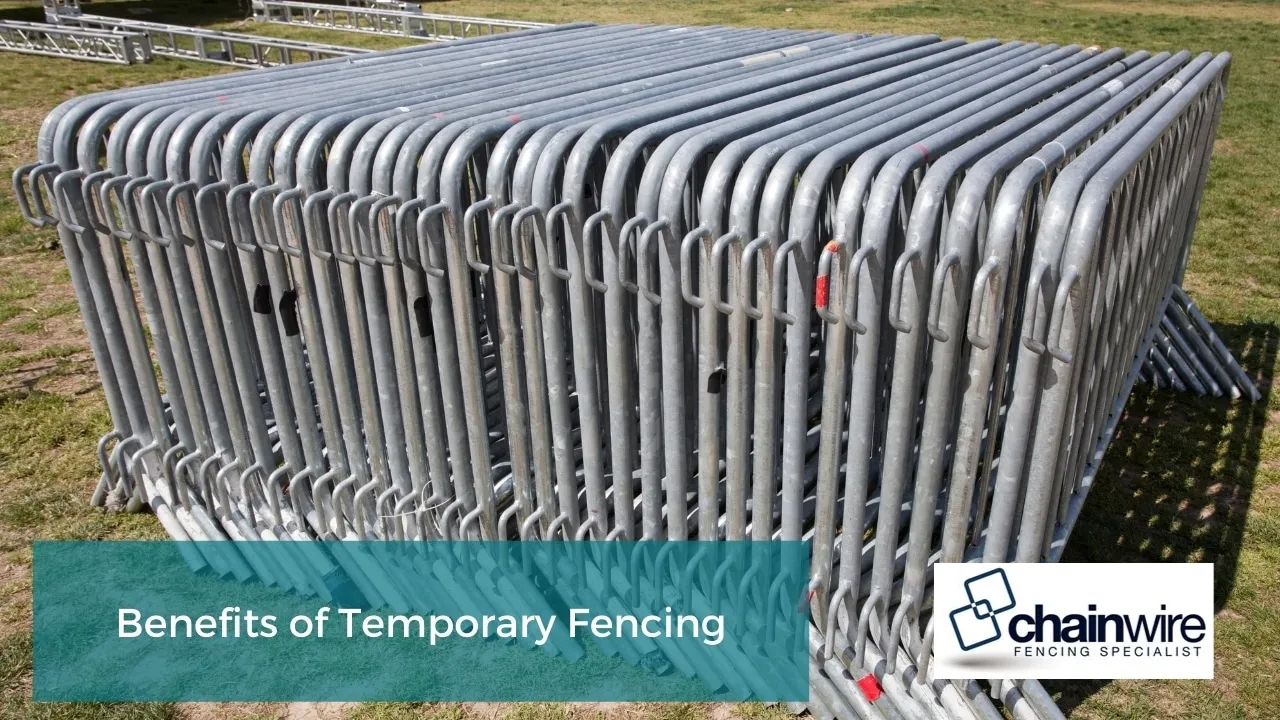
Free-standing barricades link together and stand alone, no footings, no fixing. Steel barricades are the heavier, more secure option; HDPE plastic barricades are lighter and faster to move. They are made for controlling flow rather than stopping a determined climber: directing traffic, marking road works, protecting equipment, and managing crowds and queues at events and around VIP areas. Their whole value is that you can rearrange the layout in minutes.
Screening and safety mesh
Lighter mesh and mono-filament fencing close off low-risk areas, mark exclusion zones, contain debris, or act as a visual barrier where you do not need a structural fence. It is light, easy to shift, and resists sagging and rust.
A quick comparison
| Type | Stands via | Best for | Security level |
|---|---|---|---|
| Mesh panel (temp chainwire) | Portable feet | Site perimeters, hazards, plant | Medium to high |
| Chain link on posts | Driven/cemented posts | Longer jobs, windy sites | High |
| Steel / HDPE barricade | Free-standing, linked | Traffic, crowds, events | Low to medium |
| Safety / screening mesh | Light stakes or feet | Exclusion zones, debris | Low |
Keeping a temporary run safe and legal
Temporary fencing on or near a public area is a safety obligation, not just a convenience. A few things worth getting right:
- Do not block traffic or sightlines. Keep clearance from the road, and do not obscure signs or signals. Gates on a street frontage should swing inward.
- Sign the hazards. Clear warning signage on the fence protects the public and you.
- Weight and brace it. Panels catch wind like a sail, so use enough feet, brace exposed runs, and add ballast where it is exposed. Wind-loading is the usual reason a temporary fence goes over.
- Know the standard. Temporary fencing and hoardings are covered by AS 4687, and SafeWork NSW sets out the public-safety duties around a work area. Getting this right is part of the job, not an extra.
The practical takeaway: match the type to the risk, mesh panels or chain link for a real perimeter, barricades for flow and crowds, and screen mesh for low-risk exclusion, then weight it, sign it and keep it clear of traffic. If you need temporary fencing supplied and set up properly around Newcastle, the Hunter or the Central Coast, including on sites with strict safety and access rules, we handle it end to end.