
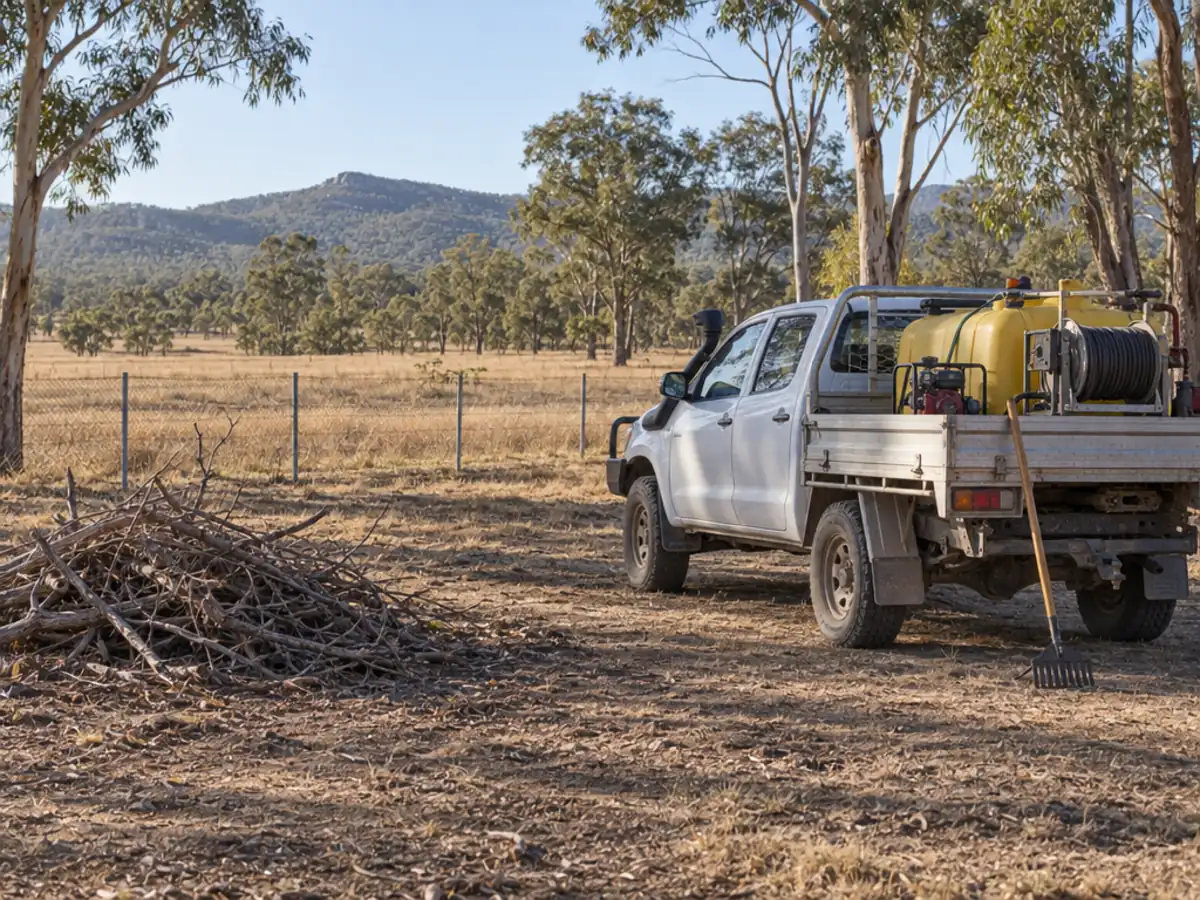
Illustration: a branch pile on cleared ground back from a chainwire boundary fence, with a firefighting ute parked nearby.
If you burn off near a boundary under a NSW fire permit, the standard conditions ask you to tell the RFS and your adjoining neighbours at least 24 hours before lighting unless the permit says otherwise, and if your fire damages the dividing fence you will usually be the one paying to restore it.
Why your neighbour hears from you before the fire danger rating does
Example burn planned for 9am Saturday, worked backwards
Example, our working
Friday 9am
Latest notice to the RFS (Fire Control Centre or Fire and Rescue station, plus the RFS online notification) and adjoining neighbours, at least 24 hours before lighting (unless specified otherwise)
Friday afternoon
RFS sets Saturday's Fire Danger Rating and any Total Fire Ban
Friday evening to Saturday morning
Check rating, wind, temperature, Total Fire Ban and EPA No Burn day (EPA website or Environment Line 131 555)
Saturday 9am
Light, permit carried on site
Saturday until out
Supervised at all times unless the permit says otherwise. Permit stays on site until the fire is extinguished
If you burn off near a boundary under a fire permit, the RFS standard conditions say the RFS and adjoining neighbours are notified at least 24 hours before lighting (unless specified otherwise). The RFS also says ratings and total fire bans are set each afternoon for the following day.
Put those two rules side by side for a burn you plan to light at 9am on a Saturday:
- Your notice has to reach your neighbours and the RFS by 9am Friday.
- Saturday's rating, and any Saturday Total Fire Ban, is set on Friday afternoon.
That's our working, not an RFS statement. It means you give notice before you know whether your day will hold.
So treat the notice as a heads-up, not a promise. Tell your neighbour the day you'd like to burn, and that it depends on Friday afternoon's rating and any ban. If the day falls through, nobody is left watching your side of the fence for smoke that never comes.
There's a second reason to get the boundary side right. If a neighbour damages or destroys a dividing fence, they will usually pay to restore it, where damage by other causes is normally shared equally. A burn that gets into the fence can turn a shared repair into one you usually pay for yourself.
Do I need a fire permit to burn off along my fence line?
Usually, and it's the second approval you need, not the first. The EPA says you must have an appropriate open burning approval from the EPA or your council before you are issued a fire permit. Which approvals apply depends on your council area, the time of year and what's near the fire.
We walk through the order step by step in Fire permit NSW: burning off a Hunter fence line takes more than one approval. For clearing along an acreage fence line, see Bush Fire Danger Period on Hunter acreage. The rest of this piece is about the people and the fence on the other side.
What should the 24-hour notice to your neighbours cover?
Plan view of a rural boundary, not to scale
The neighbour notice is one of the RFS standard permit conditions. The others, like keeping the permit on site and supervising the fire at all times, are in our fire permit guide.
The RFS Safe Burning checklist adds the RFS side of the notice. It says to contact your Fire Control Centre or Fire and Rescue station at least 24 hours before you burn and to notify the RFS through the online notification linked from that page.
The conditions say you must tell your neighbour. They don't say how. Our view is to put it in writing, by text, email or a note in the letterbox, so you both have the same details:
- The day you plan to burn, and a time window.
- Where on the fence line the pile sits.
- What's in it, such as dry fallen branches and nothing else.
- Your mobile number for the day.
- That the burn depends on the rating and any ban set the afternoon before.
Ask whether anything is stacked against their side of the fence, like firewood, hay or a stored trailer. Smoke matters too. Before lighting, the RFS says the fire must be containable within the specified area and must not cause excessive smoke, which is the part a neighbour notices first.
Who pays if a burn damages the dividing fence?
| What happened | What the source says |
|---|---|
| A neighbour (or their tenant) damages or destroys the dividing fence | They will usually pay to restore it (Legal Aid NSW) |
| Damage by other causes | Normally shared equally (Legal Aid NSW) |
| A burn breaches the Rural Fires Act 1997 | Substantial fines and up to 12 months' prison; civil suits for compensation can also be brought (NSW RFS) |
Legal Aid NSW sets out the usual position. If a neighbour, or their tenant, damages or destroys a dividing fence, they will usually pay to restore it. Damage by other causes is normally shared equally.
The fence may not be the only cost. The RFS says breaches of the Rural Fires Act 1997 can bring substantial fines and up to 12 months' prison, and civil suits for compensation can also be brought.
If the fence needs fixing fast, urgent dividing-fence work can proceed without a Fencing Order. Entering your neighbour's land without permission can be trespass, though, outside the listed cases of agreement, an order or urgent work. A message to your neighbour before you step over the line costs nothing.
Our page on legal rules for fencing in NSW covers dividing fence obligations more broadly.
What stays out of a fence-line burn pile?
If you are approved to burn, keep these out of the pile
The fire must also be containable within the specified area and must not cause excessive smoke.
The EPA says you must not burn tyres, coated wire, paint and solvent containers, or certain treated timbers. The full list is in our fire permit guide. You'll find coated wire, painted palings and possibly treated posts on most old fence runs.
That matters most after a storm, when a damaged fence and fallen branches end up in the same heap. If the old run is coming out anyway, strip the wire and posts off the fence line before any vegetation is burned, keep them in a separate pile, and ask your council how to dispose of them. Our guide to fence repairs after storm damage covers the repair side.
What can stop the burn on the morning you planned it?
Greater Hunter Fire Danger Rating, late October to early November 2026
A permit doesn't override a ban: a Total Fire Ban automatically suspends the permit, and an EPA No Burn day does the same. Ratings change several times a week, too. In one week in late October and early November 2026, the Greater Hunter rating changed three times.
So check the rating, any ban and the EPA No Burn list on the morning. You can call the Environment Line on 131 555. The rest of the day-of checks are in our fire permit guide. If a fire gets out of control, call Triple Zero (000).
Morning of the burn
If a Total Fire Ban is declared: don't light. The permit is suspended and may resume if it hasn't expired. A cancelled permit needs a new application.
Out of control: call Triple Zero (000).
What does a Total Fire Ban stop along the fence line?
During a Total Fire Ban
| Activity | During a ban |
|---|---|
| Fires in the open | Not allowed |
| Welding, grinding or gas cutting in the open | Not allowed |
| Slashing or tractor work | The RFS recommends reconsidering |
| Solid-fuel barbecue or pizza oven (wood, charcoal, heat beads) | Can't be used |
| Total Fire Ban exemption application | Minimum processing time 7 days |
Penalties (checked November 2026)
| Case | Penalty |
|---|---|
| On-the-spot fine | $2200 |
| In court | Up to $5500 and/or 12 months gaol |
| A fire that escapes and causes damage | Maximums of $132,000 and/or 14 years gaol |
More than the burn. A Total Fire Ban means no fires in the open, and hot works such as welding, grinding or gas cutting aren't allowed in the open. The RFS also recommends reconsidering slashing or tractor work, which covers a lot of fence-line jobs. You can't use a solid-fuel barbecue or pizza oven either.
If you need hot works on a ban day, the RFS lists a minimum processing time of 7 days for a Total Fire Ban exemption application, so it can't be sorted the afternoon before.
Breaking a ban is expensive. The RFS lists an on-the-spot fine of $2,200, or up to $5,500, 12 months in prison, or both in court, and maximums of $132,000, 14 years in prison, or both for a fire that escapes and causes damage (checked November 2026).
A fence-line burn at a glance
A fence-line burn in five steps
Open burning approval from the EPA or your council comes before a fire permit is issued
Fire Permit: free (checked November 2026). Required during the Bush Fire Danger Period (1 October to 31 March, may vary locally) in Rural Fire districts, at all times in Fire and Rescue districts, and at all times if a fire is likely to be dangerous to a building. Outside the period in a Rural Fire District, land clearance and fire-break fires need no permit
Notify the RFS and adjoining neighbours at least 24 hours before lighting (unless specified otherwise)
On the day: check the rating, Total Fire Ban and EPA No Burn day. A ban suspends the permit
Keep out of the pile: tyres, coated wire, paint and solvent containers, certain treated timbers (ask your council)
Total Fire Ban on-the-spot fine $2200 (checked November 2026)
Five steps, in order. First, open burning approval from the EPA or your council. Next, the RFS permit where one is required. Then 24 hours' notice to the RFS and your neighbours. On the morning, check for a rating change, a ban or a No Burn day. Throughout, keep the old fence out of the pile. Save it to your phone and check it again the afternoon before you light.
If the old fence is coming out anyway
Sometimes the cleanest fence-line burn is the one you don't need. If the run along your boundary is old coated wire and tired posts, replacing it may make more sense than working around it in a pile. Your neighbour will want to talk about that too, since a dividing fence is usually a shared job.
If you're on bush fire prone land, check with council first: Legal Aid notes that councils may restrict easily flammable fence materials. Our guide to the best fence types for bushfire-prone areas is a good place to start.
Chainwire Fencing Specialist builds chainwire, steel, aluminium and rural fencing across Newcastle, the Hunter Valley and the Central Coast, and has done since 2004. When you're ready to plan a new boundary fence, ask us for a fencing quote or call 02 4023 5416.
Sources
- https://www.rfs.nsw.gov.au/fire-information/bush-fire-danger-period
- https://www.rfs.nsw.gov.au/plan-and-prepare/farm-fire-safety/safeburning
- https://www.rfs.nsw.gov.au/plan-and-prepare/know-your-risk/Bush-fire-hazards-and-your-property/fire-permits
- https://www.rfs.nsw.gov.au/fire-information/fdr-and-tobans
- https://www.rfs.nsw.gov.au/fire-information/fdr-and-tobans/total-fire-ban-rules
- https://www.epa.nsw.gov.au/Your-environment/Air/open-burning-reducing-pollution
- https://www.legalaid.nsw.gov.au/my-problem-is-about/my-neighbour/fences/your-rights-and-obligations
Pictures in this guide are illustrations, not photos of our jobs.