
Illustration: smoke haze over rooftops and trees.
While the Bush Fire Danger Period runs you need a fire permit to burn off on most Hunter and Central Coast acreage, you may be able to clear up to 25 metres inside your boundary if your land is mapped for it, and only a solid, non-combustible fence screens a house from embers and heat, so chainwire belongs on boundaries and stock lines.
If your acreage is around Singleton, Muswellbrook or the Upper Hunter, the Bush Fire Danger Period didn't start on 1 October this year. The period doesn't start on 1 October everywhere: in 2026 the start was brought forward to 1 September for the Liverpool Range and Upper Hunter districts and for Singleton and Muswellbrook.
That catches three of the ten Hunter and Central Coast council areas where the RFS lists permits as required. It also makes the season longer there. If the period runs to the statutory 31 March, burning off in those areas needs a permit for 212 days this season, against 182 for the rest of the region. That's our estimate: September's 30 days added to the 182 days from 1 October to 31 March.
For acreage owners the danger period raises three questions: when you can burn, how much you can clear along the fence line, and which fences help rather than feed a fire. Here's what the rules allow, where they stop, and where Chainwire Fencing Specialist would and wouldn't put chainwire on a rural block.
Bush fire danger period NSW: which start date applies to you
Bush Fire Danger Period, 2026 to 2027
The statutory period is 1 October to 31 March and may vary due to local conditions. Check your own district.
The statutory Bush Fire Danger Period runs 1 October to 31 March, "however it may vary due to local conditions". Outside the brought-forward areas, all remaining districts kept 1 October in 2026. Check your own district rather than assuming either date.
A wet spring doesn't switch the period off. In August the NSW Government said El Niño is established, with above-average temperatures and below-average rainfall likely. The Bureau's October outlook then put November to January rainfall likely above average across north-eastern NSW. The permit rules apply whatever falls from the sky. Grass that shoots up in a wet spell still dries out against a fence.
Fire permit on a rural property: the checks before you light up
Before you light up
During the period, a Fire Permit is needed to light a fire in the open. Permits are free (checked October 2026). In Rural Fire Districts you apply online to the RFS.
Once you have one, two conditions come standard. You must carry the permit on site when lighting. You must also notify the RFS and adjoining neighbours at least 24 hours beforehand, unless the permit says otherwise. If you're burning a pile near the boundary fence, the people on the other side of that fence are exactly who that notice is for.
On the day itself, a Total Fire Ban automatically suspends a permit. You must also check for an EPA No Burn day.
This is not paperwork to skip. Breaches of the Rural Fires Act 1997 can bring substantial fines and prison terms of up to 12 months.
Do you need a fire permit outside the danger period?
| Situation | Permit? |
|---|---|
| Fire in the open during the danger period | Needed |
| Any time of year, a fire likely to be dangerous to a building | Needed |
| Outside the danger period, a fire for land clearance or a fire break | Not needed |
| Outside the danger period, a cooking fire in a permanent fireplace with 2 m cleared all round | Not needed |
A permit is not only a summer matter: one is needed at all times if a fire is likely to be dangerous to a building.
Some fires are exempt once the period ends. Outside the danger period, fires for land clearance or a fire break don't need a permit. Nor do cooking fires in a permanent fireplace with 2 m cleared all round.
How far can you clear along your fence line?
Plan view of a rural holding, not to scale
Check your own property in the RFS online tools. Run the boundary tool on the day you clear and keep the printout.
On mapped rural land, the answer can be up to 25 metres. The Rural Boundary Clearing Code lets landholders in mapped areas clear vegetation, including trees, within 25 m of their holding boundary without approval.
Read the conditions closely, because each one narrows it:
- The 25 m is measured on your side only.
- It applies only to land zoned rural (RU1 to RU6), mapped as bush fire prone, and where the council has not stayed out of the scheme.
- It applies to the boundary of the whole "holding", not each lot. That means it may cover all, part or none of your boundary.
Closer to the house, a different rule applies. Under the 10/50 scheme, in a designated area, trees within 10 m and shrubs within 50 m of a home can be cleared without approval. The distance is measured from the external walls of the building, and clearing is on your own land only.
The 10/50 scheme has limits of its own:
- Clearing relying on a neighbour's building needs that owner's written consent.
- Farm sheds are covered.
- You can't clear before a final occupation certificate.
- Tenants need the landowner's approval.
That RFS 10/50 page carries older content, so check the current RFS online tool before relying on it.
Neither rule tells you what applies to your block. The RFS online tools do that, and nothing in this article replaces them. Keep in mind the duty behind all of this. Under s63(2) of the Rural Fires Act 1997, a landowner must take notified steps, or other practicable steps, to prevent fires and minimise their spread.
What the boundary clearing code won't let you clear
Still off limits
- Slopes over 18 degrees: no tree removal, or pruning over 25% of the canopy, without a geotechnical report
- Riparian land
- Clearing chains between two machines
- Aboriginal scarred trees
- Anything beyond the minimum needed
Boundary unclear? Get a surveyor first.
Even where the 25 m code applies, the RFS boundary clearing tool sets hard limits:
- No tree removal, or pruning of more than 25% of the canopy, on slopes over 18 degrees without a geotechnical report.
- Riparian land is excluded.
- Clearing chains between two machines are not allowed.
- Aboriginal scarred trees may not be cleared.
- Clear only the minimum needed.
Then protect yourself. Run the RFS tool on the day you clear and keep the printout as evidence.
The boundary matters most of all. An old fence line is not proof of where your land ends. If you're unsure, the RFS says to get a surveyor, because clearing land that isn't yours is unlawful. Do that before the slasher or dozer goes in, not after.
Fencing in bushfire prone areas: what each fence type does in a fire
| Fence type | What CSIRO says | Where it fits |
|---|---|---|
| Solid non-combustible (brick, stone, concrete, galvanised iron) | Can screen a home from embers, heat, flame and wind | Near the house |
| Timber | Can ignite and carry fire, "all timbers can burn" | Away from windows, doors, decks and eaves |
| Porous (chain link, gapped picket) | Listed as designs to avoid as a barrier | Boundaries, paddocks and stock lines, not a house screen |
| Exempt fences on bush fire prone land must be non-combustible or hardwood (NSW Planning Portal) | ||
We've built chainwire fencing since 2004, and we won't dress it up. CSIRO's advice is to avoid porous designs such as chain linked fences and gapped picket-fences as a barrier. Steel mesh is non-combustible, so it won't burn. It also won't stop embers or radiant heat passing through. Chainwire earns its place on boundaries, paddocks and stock lines, not as a shield for the house.
The shield is a different fence. According to CSIRO, a solid non-combustible fence (brick, stone, concrete, galvanised iron) can screen a home from embers, heat, flame and wind.
Timber is the one to place carefully. CSIRO notes that timber fences can ignite and carry fire, and "all timbers can burn".
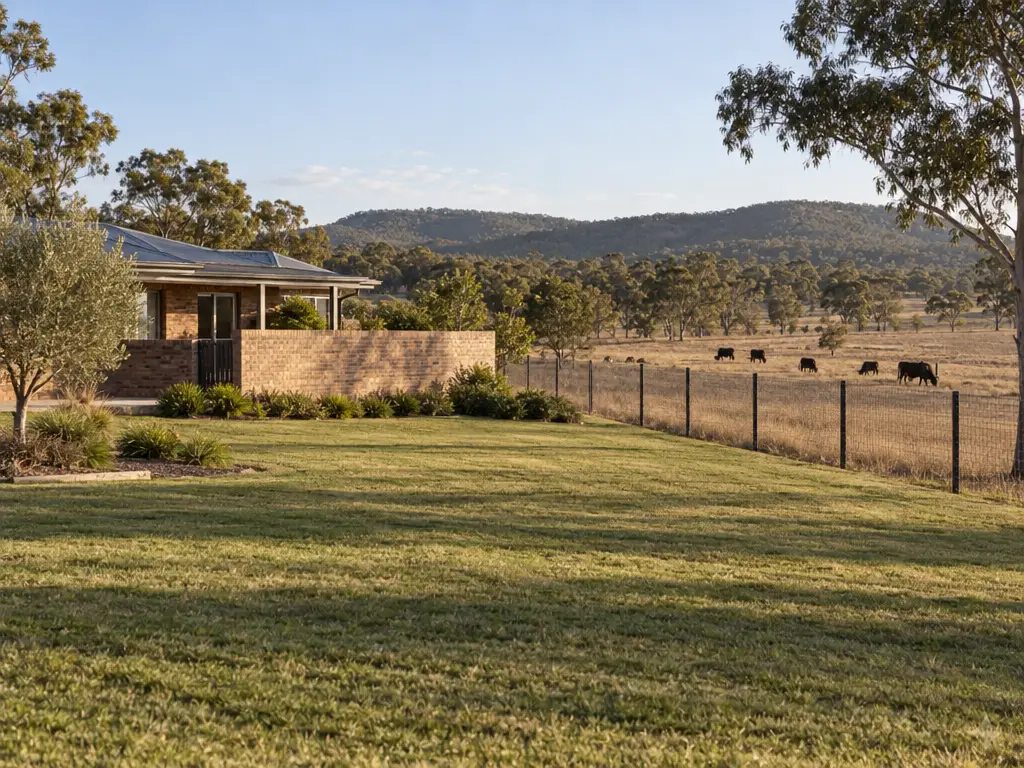
On a typical Hunter block, that points to a sensible split. Put a solid non-combustible screen where the house faces the bush. Use steel post and wire or chainwire for the long boundary and stock runs. For more on materials, see our guide to best fence types for bushfire-prone areas and our piece on chainwire coatings, powder coating and galvanising.
Rules for a new fence on bush fire prone rural land
Bush fire prone land, exempt standards
Rural zones, exempt standards
Planning Portal page last updated June 2023. Exempt development is one path, not the only one. Confirm with council.
If you want to skip planning approval, the exempt development standards set the materials. On bush fire prone land, a fence must be constructed of non-combustible materials or hardwood. Two more conditions apply: gates must not open outwards, and metal parts must be low-reflective, factory pre-coloured.
Rural and environmental zones add their own exempt standards:
- Height up to 1.8 m, built as post and wire or post and rail.
- Masonry is allowed within 3 m either side of the property entrance from the primary road.
- Electric fencing must follow AS/NZS 3014:2003.
- Check with council before removing or pruning vegetation.
Treat these as one approval path, not the only one. The Planning Portal page was last updated in June 2023, and zone rules vary. A fence that falls outside these standards may still be possible with council approval, so confirm with your council first. Our page on council permits for fence installation in Newcastle covers how that conversation usually starts.
Neighbours come into it too. A boundary fence also falls under the Dividing Fences Act 1991, which our NSW fencing laws guide explains.
Finally, think about access before a new fence or gate goes across a track. Firefighters rely on roads and tracks on private and public land. Fire Trail Standards gazetted 1 Dec 2023 cover trail width, clearances and accessibility. If a track on your land may be a fire trail, talk to your RFS Fire Control Centre before you fence it.
Keeping the fence line clear through summer
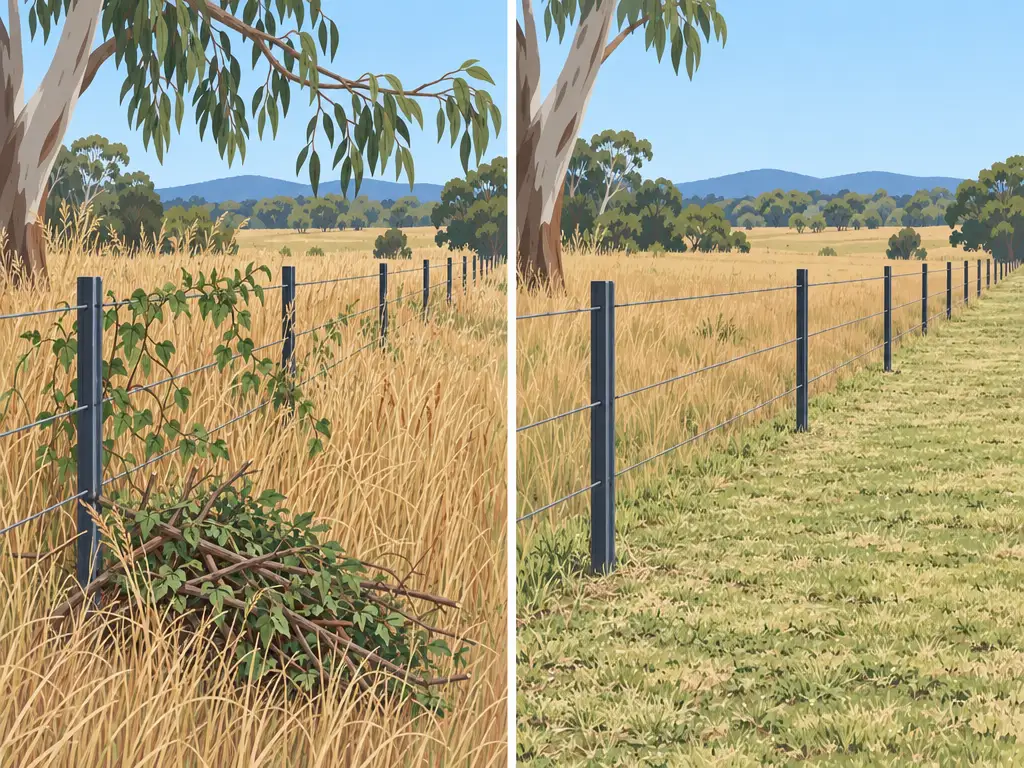
A fence line is a ready-made fuel strip if you let it be one. CSIRO's upkeep advice is simple. Keep fences clear of overhanging branches, vines and creepers, and don't store garden waste or mulch against them. If you have timber fencing, site it away from windows, doors, decks and eaves.
On acreage, that means three jobs. Slash the grass along both sides of your own fence runs. Pull out the creeper that's woven through the wires. Move the prunings pile off the corner post.
While you're walking the line, check the fence itself. Our chainwire maintenance and repair guide covers sagging mesh and loose ties.
70% of people say they have a bush fire plan, but fewer than half have prepared their property.
Plenty of people stop at the plan. RFS research reported by the Singleton Argus found 70% of people say they have a bush fire plan, but fewer than half have prepared their property. Clearing the fence line is preparation you can see.
If fire damages a boundary fence and stock get out
Normally you serve a Fencing Notice on your neighbour before repairing a shared fence. Urgent repairs are the exception. You can do the work without a notice, and claim half the cost, only if a dividing fence existed and serving notice was impractical (for example, stock loss).
The time limits are long and short. You have 6 years to apply to claim, or 1 month to challenge. Photograph the damage and keep your receipts.
Hunter acreage fire season figures at a glance
Danger period
1 October to 31 March (statutory)
RFS
2026 start: Upper Hunter, Liverpool Range, Singleton and Muswellbrook
1 September 2026
2NM
Permit notice to neighbours and RFS
At least 24 hours
RFS
Rural Boundary Clearing Code
25 metres from holding boundary
RFS
10/50 scheme
Trees 10 metres / shrubs 50 metres from external walls
RFS
Boundary code slope limit for tree removal
18 degrees
RFS
Exempt rural fence max height
1.8 metres
NSW Planning Portal
Every figure above, in one place, each with its source. The rules behind them vary by council, zone and site, so use this as a starting point and confirm with your council or RFS Fire Control Centre.
Getting the fence right for your block
Start with your district's dates and the RFS online tools. They tell you when you can burn and how much you can clear. After that comes the fence.
Chainwire Fencing Specialist builds rural, steel, chainwire and aluminium fencing and gates across Newcastle, the Hunter Valley and the Central Coast. If you're replacing a boundary run or planning a new paddock line, tell us about your block through our fencing quote form, or call 02 4023 5416.
Sources
- https://www.rfs.nsw.gov.au/fire-information/BFDP
- https://www.2nm.com.au/local-news/bush-fire-danger-period-brought-forward/
- https://www.singletonargus.com.au/story/9340935/rfs-hunter-valley-bush-fire-danger-period-starts-september-1/
- https://www.nsw.gov.au/ministerial-releases/preparations-for-bush-fire-season-advance
- https://www.bom.gov.au/climate/ahead/outlooks/
- https://www.rfs.nsw.gov.au/plan-and-prepare/boundary-clearing-tool/boundary-clearing-faq
- https://www.rfs.nsw.gov.au/plan-and-prepare/boundary-clearing-tool
- https://www.rfs.nsw.gov.au/plan-and-prepare/1050-vegetation-clearing
- https://research.csiro.au/bushfire/landscaping/fences-and-walls/
- https://www.planningportal.nsw.gov.au/development-and-assessment/planning-approval-pathways/exempt-development/fences
- https://www.rfs.nsw.gov.au/plan-and-prepare/fire-trails
- https://www.legalaid.nsw.gov.au/my-problem-is-about/my-neighbour/fences/urgent-fencing-work
Pictures in this guide are illustrations, not photos of our jobs.