
Burning off along a rural fence line in the Hunter usually takes more than a fire permit: confirm you may clear the line, get any council or EPA burning approval your area needs, then apply for the RFS permit and notify neighbours, and check on the day that nothing has switched it off.
How many approvals does a fence-line burn-off need?
Up to four, plus a notice and a check on the morning. On Hunter acreage, the fire permit everyone talks about is usually the last approval you get, not the first.
The order runs like this:
- Make sure you're allowed to clear the fence line.
- Get any council or EPA open-burning approval your area needs.
- If it's a hazard reduction burn, get any certificate that applies.
- Apply for the RFS Fire Permit.
- Give notice.
- On the day, check that nothing has suspended the permit.
The steps also take time to work through. Muswellbrook Shire, as one Hunter example, asks you to allow up to 14 days for written council approval where you need it. The RFS asks you to contact the local Fire Control Centre at least 24 hours before burning, and notify neighbours at least 24 hours before.
Put those together: allow 14 days for council approval and a day's notice, so start with council at least 15 days before. Other councils set their own timelines.
The season is already under way. The statutory bush fire danger period is 1 Oct to 31 Mar, "however it may vary due to local conditions". In 2026 the start was brought forward to 1 September for the Liverpool Range and Upper Hunter districts and for the Singleton and Muswellbrook LGAs. Which start date applies to your block is covered in our bush fire danger period guide.
During the period, a Fire Permit is required for burning in Rural Fire districts, and at all times in Fire and Rescue districts. The RFS permit table lists Cessnock, Dungog, Lake Macquarie, Maitland, Muswellbrook, Newcastle, Port Stephens, Singleton, Upper Hunter and Central Coast as council areas where a permit is required. Permits are free (checked October 2026).
Can you clear the fence line in the first place?
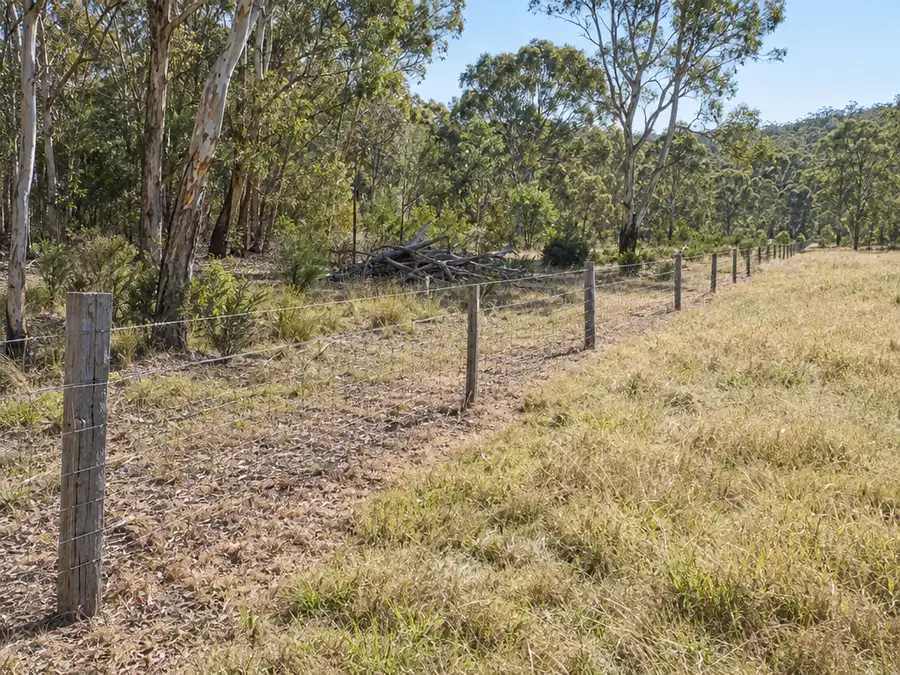
Clearing and burning are separate steps: the Rural Boundary Clearing Code covers clearing only, so the pile of branches still needs every approval below. How far you can clear, and what the code won't let you touch, is in our bush fire danger period guide, which also says to get a surveyor if you're unsure where the boundary runs.
Does your council or the EPA need to approve the burn?
Muswellbrook Shire's conditions: one council's example, check your own
A free RFS permit is often treated as the whole job. The EPA says otherwise: you need an appropriate open burning approval from the EPA or your local council before you will be issued a fire permit.
Rules also differ across the Hunter. The EPA says burning vegetation in the open is generally prohibited at all times in all council areas in the Sydney, Wollongong and Newcastle regions, and in other Schedule 1 councils. There are exceptions: the EPA or council may approve burning in some circumstances, and councils can approve burning dry and dead vegetation on large lots, subject to conditions.
Muswellbrook Shire shows how one council handles it:
- When no council approval is needed: for permitted items on land over 4,000 m² (1 acre) zoned RU1 or R5.
- Everywhere else: you need written council approval before you contact the fire authority, and should allow up to 14 days.
- Conditions on the burn: piles no bigger than 2 m x 2 m x 1.5 m high, winds under 15 km/h, water on hand, and supervision at all times.
The same page also says “Do not burn in the declared fire season (from 1st September to 31st March)”. Read that before planning a summer burn there.
Treat Muswellbrook as an example, not the rule for your block. Our advice to any Hunter landholder is to ring two places before stacking a single branch: your council and your local Fire Control Centre. The Muswellbrook page lists Hunter Valley Fire Control on (02) 6575 1200.
Is it a hazard reduction burn?
If you're burning to reduce bush fire hazard along the line, you may need a Fire Permit, an environmental approval such as a Bush Fire Hazard Reduction Certificate, or both.
The order matters. That approval must be obtained before applying for the Fire Permit. Ask your Fire Control Centre which applies to your burn.
What does the RFS Fire Permit require?
The permit comes with standard conditions. You must:
- carry the permit on site when lighting, and keep it there until the fire is out.
- supervise the fire at all times, unless the permit says otherwise.
- notify the RFS and adjoining neighbours at least 24 hours before lighting, unless the permit specifies otherwise.
The RFS checklist lets you notify online.
The permit isn't fixed once issued. It can be varied, cancelled or suspended depending on weather.
Outside the danger period, Fire Permits aren't required for fires lit for land clearance or a fire break. The exception: a permit is needed at all times if the fire is likely to be dangerous to a building. Notice still applies off-season too. As the Singleton Argus reported, regardless of time of year, neighbours and fire authorities must be notified at least 24 hours before lighting up.
What can't go on the burn pile?
| Item | RFS fire permits page1 | EPA open burning page | Muswellbrook Shire (example)2 |
|---|---|---|---|
| Tyres | tyres | tyres | tyres |
| Coated wire | coated wire | coated wires | |
| Treated timber | certain treated timbers | treated timbers | |
| Paint | paint | paint and solvent containers | |
| Plastics | plastics | ||
| Wet or green vegetation | wet or green vegetation | ||
| 1 The RFS lists tyres, plastics and paint as examples of toxic materials, not a complete list. | |||
| 2 Muswellbrook's preferred alternatives: reuse, recycling, composting or waste-facility disposal. | |||
Old fencing is where good intentions go wrong. Pulling out a tired boundary fence leaves wire, posts and offcuts, and the pile of branches looks like a handy place for them. It isn't.
Each source sets its own limits:
- RFS: the fire must not contain toxic materials such as tyres, plastics or paint, and must not cause an air pollution problem through excessive smoke.
- EPA: approved burns must not burn tyres, coated wire, paint and solvent containers, or certain treated timbers.
- Muswellbrook Shire: approval won't be given to burn coated wires, tyres, treated timbers, or wet or green vegetation.
Not sure what coating is on your old wire? Our guide to chainwire coatings, powder coating and galvanising explains the common finishes. Plastic-coated chainwire is plainly coated wire, so keep it off the pile.
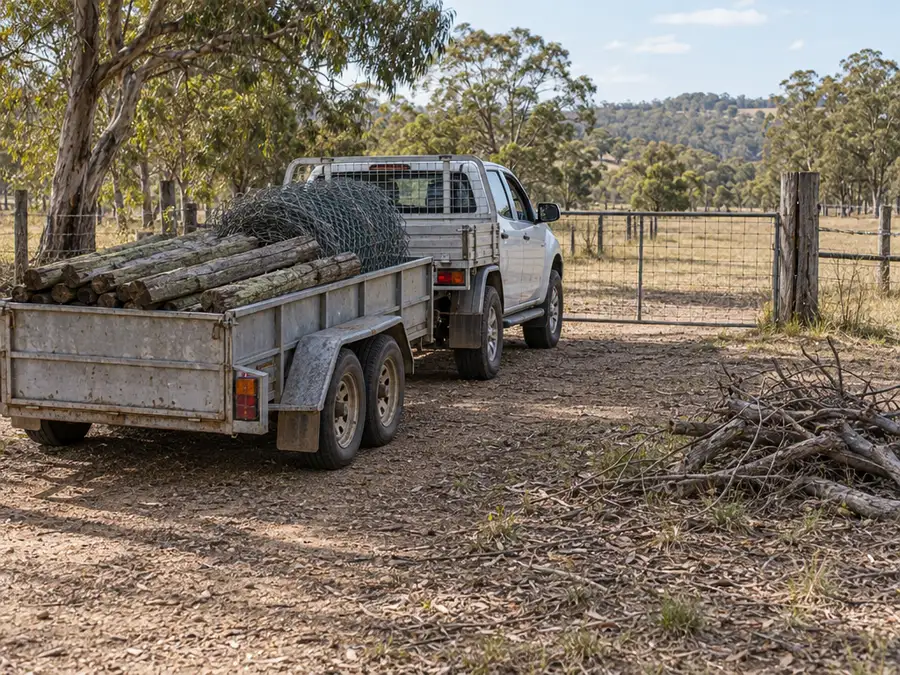
The alternatives are dull and lawful. Muswellbrook lists reuse, recycling, composting or waste-facility disposal as preferred. The RFS says there are alternative ways to get rid of waste or vegetation, and to talk to your council. Roll the old wire, stack the posts, and ask council where they go.
What can switch your permit off on the day?
Morning of the burn
Your permit can be switched off on the day, even with every approval in hand.
- A Total Fire Ban automatically suspends your permit.
- You must also check for an EPA "No Burn" day, check the weather, and check with your local Fire Control Centre or Fire and Rescue station before lighting.
- The EPA notes that no-burn notices and Total Fire Bans override permits except in specific circumstances.
Conditions shift through a Hunter summer, wet one week and risky the next. Pick a burn date, and also pick a back-up.
When you do light up:
- keep a cleared area around the burn and firefighting equipment on hand.
- if the fire gets out of control, call Triple Zero (000).
What happens if you burn without the right approvals?
Under the Rural Fires Act 1997, breaches can bring substantial fines and prison terms of up to 12 months, plus possible civil suits for losses.
Council penalties sit on top of that. Muswellbrook's page says on-the-spot fines can apply for burning without approval, burning a prohibited article, or burning without minimising air pollution. It gives a maximum court penalty of $5,500 for an individual and $11,000 for a corporation (checked October 2026).
Which figures matter for a Hunter fence-line burn?
Statutory bush fire danger period
1 October to 31 March
May vary due to local conditions
NSW RFS
Notice to RFS and neighbours before lighting
At least 24 hours
Unless specified otherwise
NSW RFS
Boundary clearing distance (Rural Boundary Clearing Code)
25 metres from holding boundary
Where the online tool shows you are eligible
NSW RFS
One council's example
Muswellbrook pile limit
2 m x 2 m x 1.5 m high
Muswellbrook Shire Council
Muswellbrook wind limit for burning
Under 15 km/h
Muswellbrook Shire Council
Muswellbrook council approval turnaround
Up to 14 days allowed
Muswellbrook Shire Council
Max court penalty, burning offences (Muswellbrook page)
$5,500 individual / $11,000 corporation
Checked October 2026
Muswellbrook Shire Council
These are the figures in one place, each with its scope. The Muswellbrook figures are one council's example, not a Hunter-wide rule.
Rebuilding the fence once the line is clear
Most fence-line burns are really the first job in a fence replacement: clear the line, deal with the old material, then build again.
We build rural, chainwire, steel and aluminium fencing and gates across Newcastle, the Hunter Valley and the Central Coast. Two of our guides can help you plan the new fence:
- Best Fence Types for Bushfire-Prone Areas, for choosing what goes back up.
- How to Maintain and Repair a Chainwire Fence, for keeping it in shape afterwards.
When the approvals are sorted and the line is ready, ask us for a fencing quote or call 02 4023 5416.
Sources
- https://www.rfs.nsw.gov.au/fire-information/fire-permits
- https://www.epa.nsw.gov.au/Your-environment/Air/open-burning-reducing-pollution
- https://www.muswellbrook.nsw.gov.au/approval-to-burn/
- https://www.rfs.nsw.gov.au/plan-and-prepare/farm-fire-safety/safeburning
- https://www.2nm.com.au/local-news/bush-fire-danger-period-brought-forward/
- https://www.singletonargus.com.au/story/9340935/rfs-hunter-valley-bush-fire-danger-period-starts-september-1
Pictures in this guide are illustrations, not photos of our jobs.