
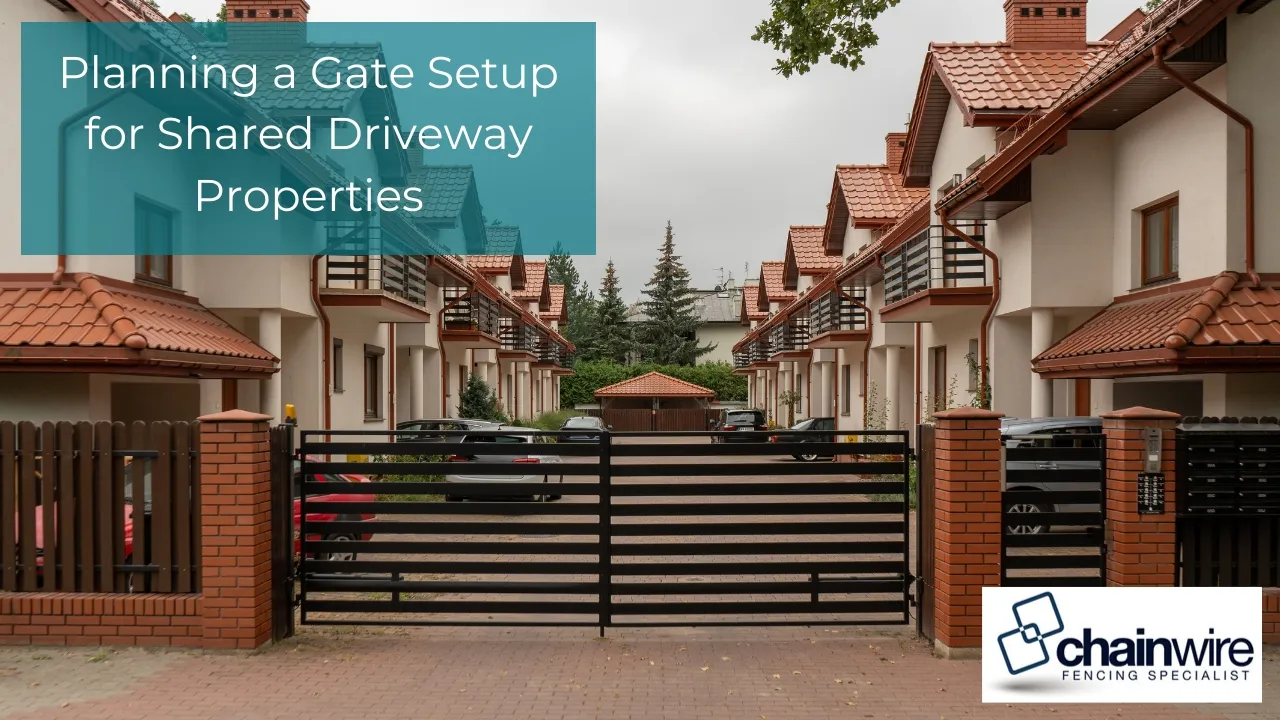
Shared driveways are practical, but adding a gate to one takes more thought than a single-property entry. With more than one household relying on the same access point, the gate has to balance convenience, security and appearance, and the arrangements behind it matter as much as the hardware. Plan it well and it serves everyone for years; plan it poorly and it becomes a source of disputes. Here is how to get it right.
Start with how the driveway is actually used
Every shared driveway is different, some wide and open, others narrow and steep. Before choosing a gate, think about the daily reality:
- Who drives in and out, and when? A gate that is fine for two cars may frustrate a household of five.
- Do delivery or work vehicles need extra width?
- Is the approach level or sloped?
These answers point straight at the gate type. A tight or sloping entry usually favours a sliding gate; a level, roomy one can take a swing gate. Our full comparison of sliding gates versus swing gates walks through the trade-offs.
Sort ownership and responsibilities early
This is the part people skip, and it causes the disputes. If the driveway is jointly owned, agree who is responsible for maintenance, servicing and repairs before the gate goes in. Put it in writing, who pays for servicing, repainting or motor repairs, so there are no misunderstandings later. Shared boundaries and access are covered by NSW dividing-fence and access arrangements; NSW Fair Trading is a good starting point on how shared costs and disputes work.
Councils may also have rules about gates across shared access points, setback from the road and visibility standards, so confirm those before committing to a design.
Choose materials and a style that fit
The gate is both a barrier and the face of the frontage. Steel and aluminium are popular for strength and weather resistance, and custom fabrication lets the gate suit the specific opening, including features like drainage grates or airflow gaps built into the design where the site needs them. Match the height, colour and infill to the adjoining fencing so the entrance looks intentional rather than tacked on. If the shared boundary is chainwire or mesh, echoing those elements ties the whole frontage together.
Get the security and safety right
Shared access can leave properties more exposed, so a well-planned gate helps. Automated entry, remotes, keypads or sensors, lets authorised vehicles through easily while keeping others out, and sturdy locks remain essential on manual gates. Two safety points not to overlook:
- Sightlines. Drivers need to see pedestrians and traffic before pulling onto the street, so keep the gate and any planting from blocking the view.
- Lighting. Lighting at the gateposts or nearby makes night use safer for everyone sharing the entry.
If you are automating the gate, the safety devices matter, our electric gate safety tips cover loop detectors, safety beams and the rest.
Get the installation and hardware right
A shared gate gets more use than a single-household one, so the build has to hold up. Accurate measurement, quality welding and well-engineered hardware are what keep a gate straight and smooth over years of daily cycles. Sliding gates need robust tracks, rollers and end stops; swing gates need strong posts and hinges sized for the leaf. These details are the difference between a gate that still runs cleanly in five years and one that sags or sticks.
The practical takeaway: plan a shared-driveway gate around how the driveway is really used, settle the ownership and maintenance agreement in writing before you build, pick a gate type to suit the space and slope, and have it installed with hardware built for heavy use. We design, fabricate and install manual and automated gates for shared driveways across Newcastle, the Hunter and the Central Coast, and can help you plan a setup that works for every household on the drive.