
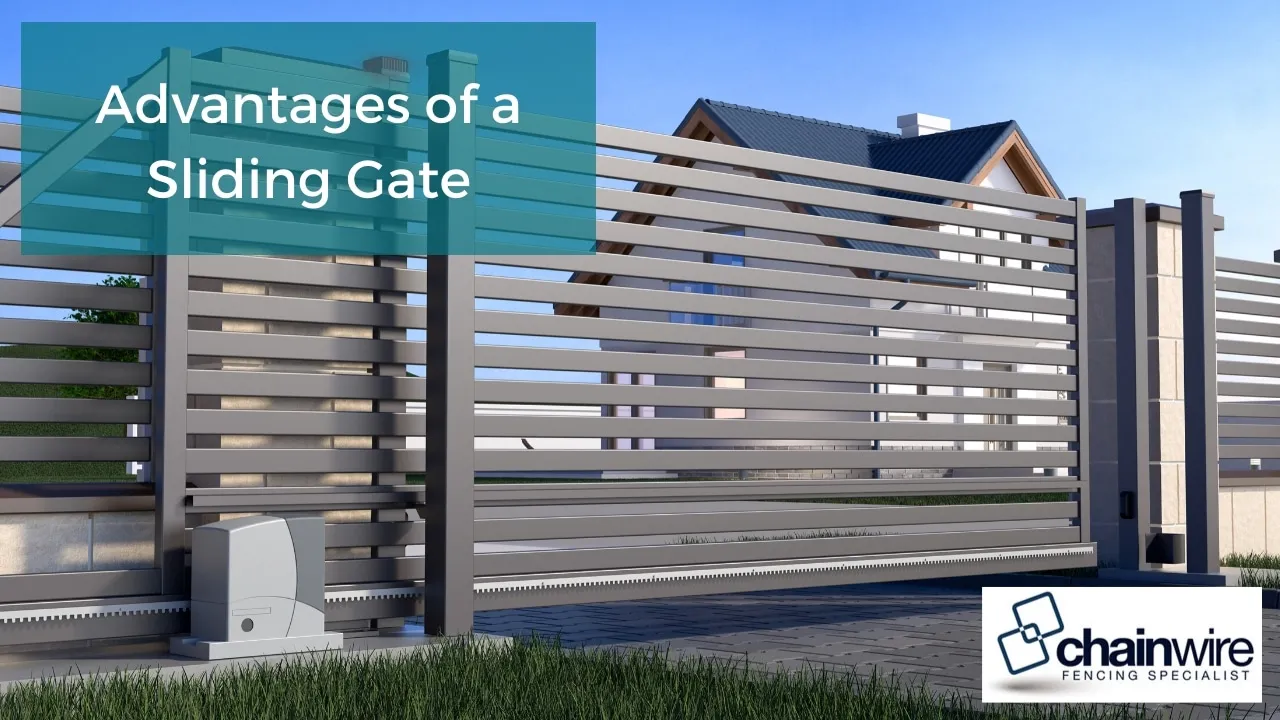
Sliding and swing gates both secure an entrance, they just do it differently, and the right one depends on your site rather than fashion. A gate that fights the slope or the available space will frustrate you every day and wear out faster. Here is an honest comparison so you can pick with confidence.
How each one works
A swing gate is hinged on posts and opens like a door, in a single leaf or a pair that meet in the middle. It is simple, has fewer moving parts, and is often the lower-cost option for a standard opening.
A sliding gate runs sideways along the fence line on a track (or cantilevered above the ground), pulled clear of the opening rather than swung through it. It needs room to one side to park the gate, but nothing in front or behind.
Side by side
| Consideration | Swing gate | Sliding gate |
|---|---|---|
| Space needed | Clear arc in front or behind | Run-off space to one side |
| Steep or sloping driveway | Struggles, the leaf can catch the ground | Handles it, gate stays level |
| Wide vehicle openings | Long leaves sag and strain hinges | Better for wide spans |
| Moving parts / wear | Fewer, hinges and latch | Track, rollers and end stops |
| Automation | Straightforward | Straightforward, favoured on big/heavy gates |
| Typical cost | Often lower to install | Track and hardware add cost |
When a sliding gate wins
- Tight frontage. If you build close to the road or the footpath, a sliding gate does not swing out into it.
- A garden or landscaping at the entry. No swing arc means nothing gets clipped as the gate opens.
- A sloping driveway. This is the big one. A swing gate has to be designed around the ground so it does not jam on the rise; a sliding gate stays level and sidesteps the problem entirely.
- Wide or heavy openings. A long swing leaf puts serious load on its hinges and tends to droop over time. A sliding gate carries its weight on rollers, so it holds up better across a wide span.
When a swing gate makes sense
- Plenty of clear space in front of or behind the opening, and a reasonably level approach.
- A standard-width opening where a single or double leaf is not fighting its own length.
- Simplicity and budget, fewer moving parts and often a lower install cost for the right opening.
Whichever you choose, get these right
- Match the gate to the fence. Same height and strength, built from the same mesh or panel, so the gate is not the weak point in the boundary.
- Plan the hardware. Sliding gates need a solid track or cantilever, quality rollers and proper end stops so the gate cannot run off the rail. Swing gates need strong posts and hinges sized for the leaf. Our electric gate safety tips cover the safety devices that matter on any automated gate.
- Think about automation early. Both types automate well. If you are motorising a heavy or wide gate, a slider is usually the easier, longer-lasting choice, and the footings and power need to be planned in, not retrofitted.
The practical takeaway: let the site decide. Sliding gates win on tight frontages, slopes and wide openings; swing gates suit level, roomy entries on a tighter budget. Get the height, hardware and footings right and either will serve for years. We design, fabricate and install both, manual and automated, across Newcastle, the Hunter and the Central Coast, and we are happy to advise which suits your entry.