
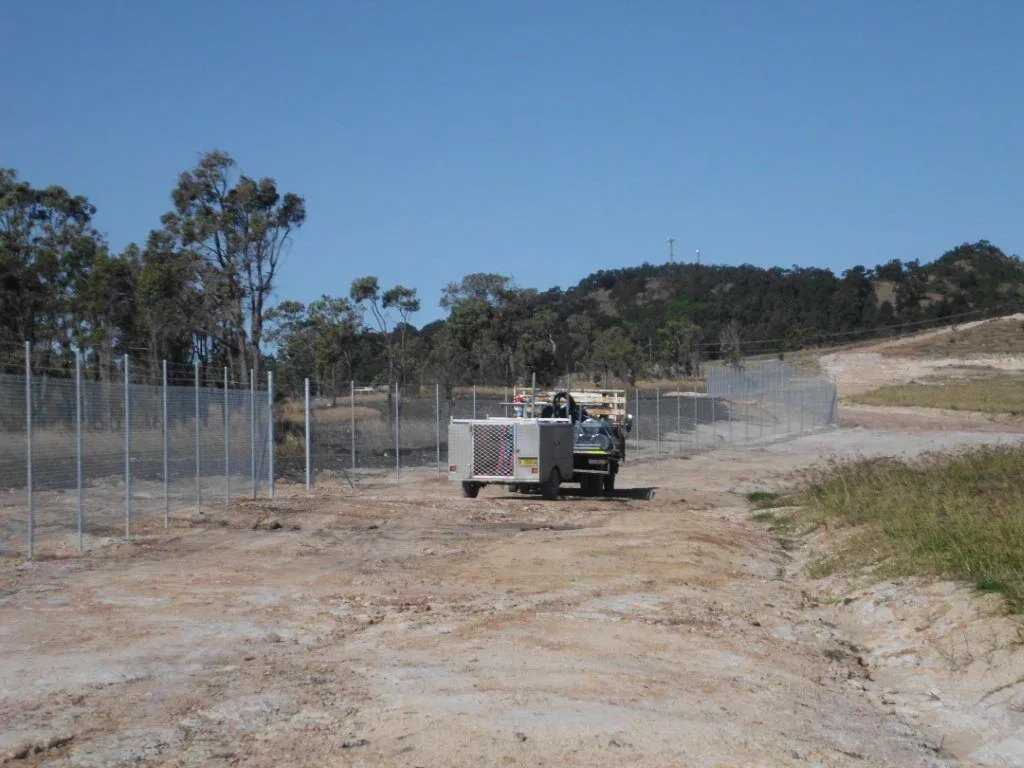
Barbed wire is a practical, low-cost way to control access over a long boundary. It suits properties where you do not need to block the view, just make the line hard to cross: rural paddocks, remote perimeters, industrial yards, substations, pump sites and towers. We supply and install it as a standalone fence or as a topping that lifts the protection on an existing fence.
What it is used for
- Rural boundary and livestock fencing
- Property perimeters in remote or open areas
- Commercial yards needing a low-cost deterrent
- Access restriction around infrastructure
- Top runs above standard fencing for added height and deterrent
Configurations
We build barbed wire to suit the site, the span and the ground:
- Standard three to five strand runs
- Barbed toppings over existing fences or mesh
- High-tension systems for longer distances
- Tapered or angled arms to make the top harder to clear
- Steel or concrete posts chosen for soil and span
- End assemblies, strainer posts and line supports as required
Galvanised construction resists corrosion in the open, the barbs sit at fixed spacing, and inline strainers let us set and later correct the tension. Because it is a low-visual, scalable barrier, it covers large boundaries cheaply and needs very little upkeep once it is up.
Adding barbed wire to a chainwire fence
One of the most common jobs is topping a chainwire fence with angled arms and three strands of barb, taking a 1.8 m security fence up to something far harder to climb. We install the arms and tension the wire to match the existing line.
Pairing and upgrades
Barbed wire works with other systems when a site needs more:
- Chainwire under-runs or buried mesh to stop digging
- Extra strand rows for a higher deterrent
- Warning signage where required
- Razor wire where a higher level of protection is justified
Razor wire and public-facing barbed toppings can be subject to local council rules, so we confirm what is allowed before quoting rather than installing something that has to come down.
Maintenance
Galvanised wire resists corrosion, loose tension is corrected with strainers, and a single damaged section can be replaced without pulling down the run. A check every six to twelve months keeps tension right and catches animal or storm damage early.
Tell us the boundary length and whether it is a new fence or a topping, and we will spec the strands, arms and posts to match.