
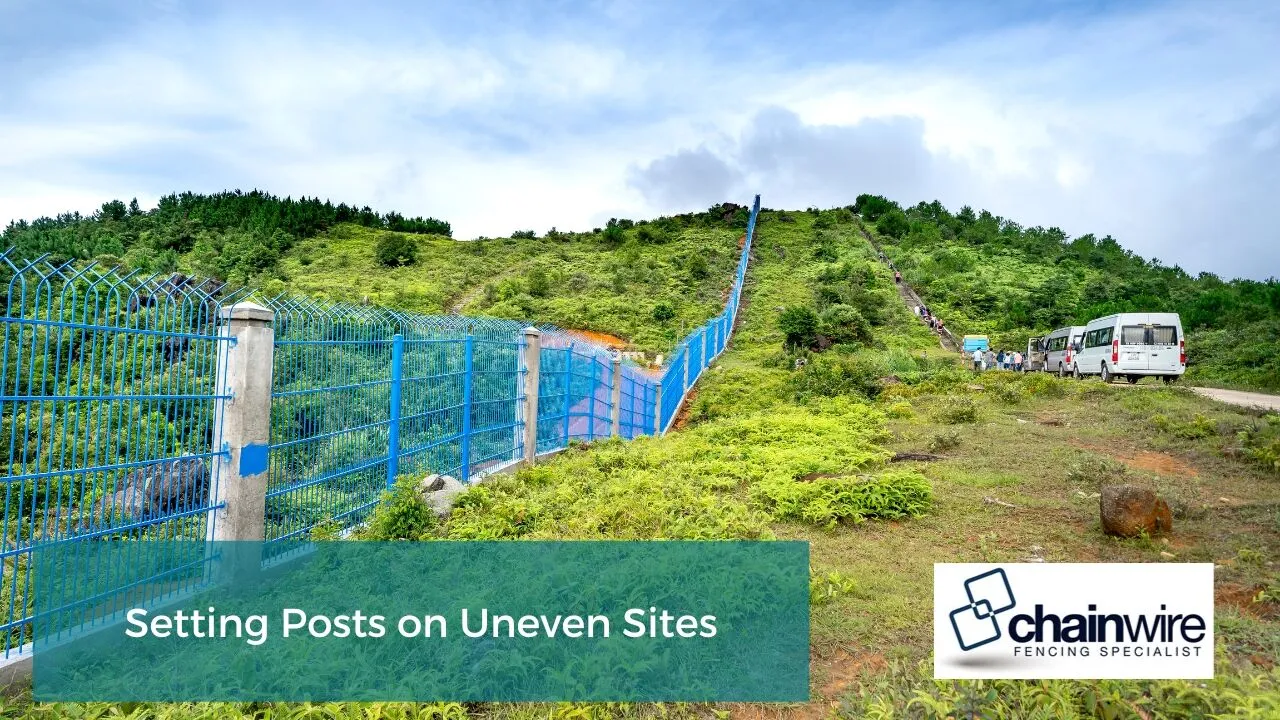
Completely flat land is the exception, not the rule, in both town and country. A slope changes how posts are set, how the fence lines up, and where gaps can open under the base, but none of that stops you fencing the block well. It comes down to reading the ground and choosing the right method. Here is how to fence a slope without losing stability or leaving holes.
Start by reading the slope
Before anything else, mark the full fence line and measure the elevation changes with a level or slope gauge. The method follows the grade: gentle grades suit a racked fence that follows the ground, sharper inclines suit a stepped fence, and a block that changes along its length may need both across the same run. A string line pulled along the top keeps post heights uniform so the finished fence reads straight even where the ground is not.
The three methods
Level-topped fence. For ground with only small dips and rises, a level-topped fence keeps a straight, level top edge and the low spots underneath are filled afterwards with soil, turf or gravel. It is the neatest-looking of the three and suits gently undulating suburban blocks.
Stepped fence. On steeper slopes, a stepped fence sets each panel a step up or down from the last, following the grade like a staircase. It needs little ground levelling, but it leaves a triangular gap under each panel where the ground falls away, and those gaps have to be filled, especially if the fence is meant to contain small pets. The top edge is stepped rather than smooth.
Racked fence. A racked fence follows the contour of the ground with angled rails, so there are no gaps under the base at all. It is the most demanding to build and most manufacturers recommend it for slopes of around 10 degrees or less, beyond which it can start to look uneven.
This is where chainwire has a real edge. The mesh racks to follow a slope smoothly and adjusts to changing ground far more easily than a rigid panel, which is why chainwire suits long boundaries and rural runs over uneven terrain.
Setting posts on uneven ground
Posts do the work of holding a fence stable on a slope, so they go deeper and stronger than on flat ground. Post holes are typically 600 mm to 900 mm deep depending on soil type and slope angle, and longer posts are used to keep the height even across the line. Add gravel at the base of each hole for drainage, set the post in concrete, and backfill with compacted soil. At corners and gates, use deeper footings or bracing, because those points take the most ground pressure. Keep the post spacing uniform and check alignment against the string line before the mesh or panels go on.
Prepare the site first
Good site prep saves rework. Before installation:
- Clear vegetation along the fence line and mark the boundary accurately.
- Confirm the property lines, and locate underground services before digging.
- Record the elevation changes and identify erosion-prone sections.
- If the site drains poorly, lay gravel beds or reroute water flow, because poor drainage is what moves posts over time.
Getting the slope method right from the start depends on knowing the site, so this step is not one to skip.
Fill the gaps under the base
Whichever method you use, low spots and triangular gaps under the fence need filling, both for looks and to stop pets or pests getting under. Compacted gravel, soil or a timber rail along the base all work, and planting along the fence line softens the irregularities on a residential block.
Cost: a slope takes more work
A sloped install involves more than a flat one: deeper digging, extra concrete for the deeper posts, angled cuts, custom fitting and sometimes drainage or retaining work. That adds labour and time, so a sloped site costs more than the same length on flat ground. Planning for it early avoids surprises partway through the job.
Why use a contractor on a slope
Errors in post depth, slope layout or panel fitting on a slope show up quickly as a fence that shifts, sags or needs early repair. A contractor sets the method to the soil, grade and how the property is used, reinforces posts where the ground demands it, handles drainage, and works to council standards. On a steep or awkward block, that judgement is what keeps the fence standing straight for years.
The takeaway
A slope is a method choice, not a barrier. Read the grade first, then pick level-topped for gentle ground, stepped for steep slopes, or racked to follow the contour without gaps, and lean on chainwire where the ground is long and uneven. Set the posts deeper, drain the site properly, and fill the gaps under the base. Get those right and a sloped block ends up with a fence just as stable and tidy as a flat one.