
Plenty of sites install a fence without thinking about how someone would get past it. Chainwire (also called cyclone fencing or chain mesh) is strong, but it does not do its job if the height is too low, the gate is the weak link, or the base lifts. Those are the exact spots intruders test on construction sites, warehouses, school grounds and industrial yards.
Even with sound mesh, someone can lift the bottom, climb over, or slip through a gap where the fence meets a building. It usually goes unnoticed until tools, stock or equipment go missing. The fix is to treat the fence as one working system rather than a roll of mesh on some posts. Here is where the real gains are.
Get the height right for the risk on each side
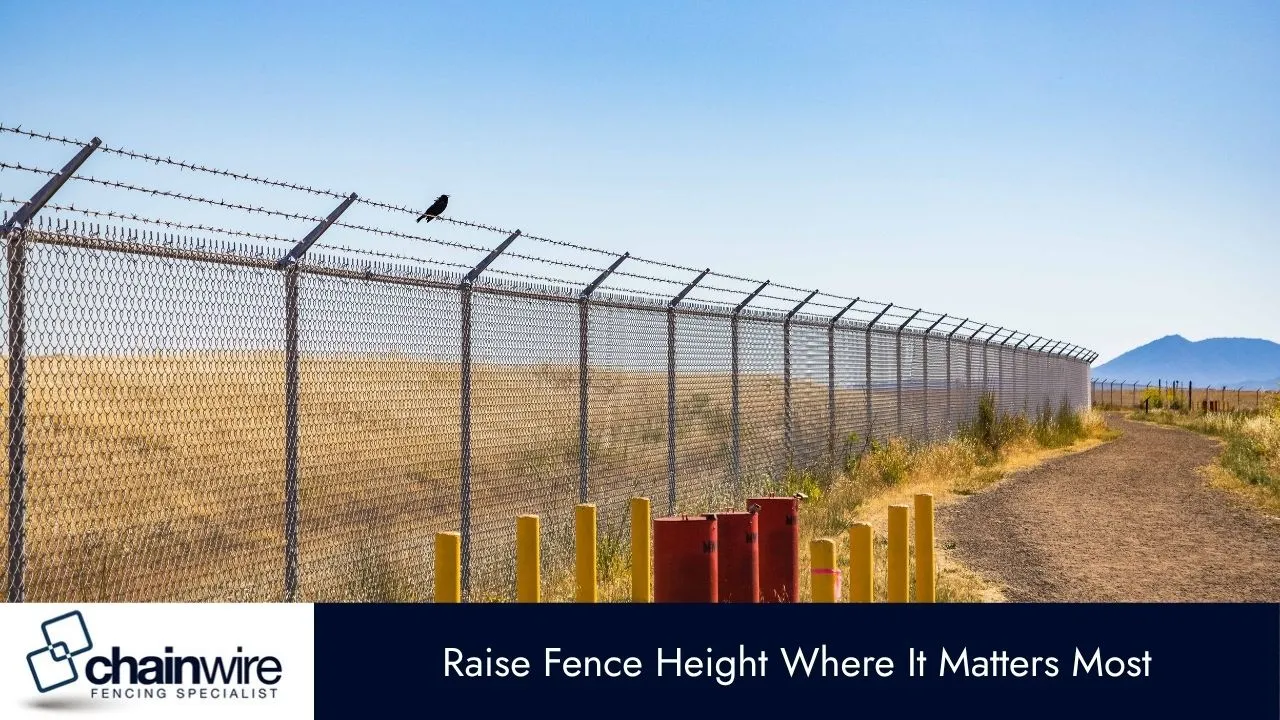
A low fence next to a public path can be climbed in seconds. Height should follow the exposure, not a single number stamped around the whole boundary. Sides facing open streets, back lanes or bushland carry more risk and earn more height.
Standard security heights sit between 1.8 and 2.4 metres. Lifting that toward 3 metres at the pressure points makes climbing much harder, and a top extension angled outward with three strands of barbed wire removes the handhold at the top rail. Keep the upper mesh under tension so it cannot be pushed down and stood on.
Make the gate as strong as the fence
Gates move more than any other part of the fence, so hinges loosen, latches wear and locks get easier to force. A secure run of mesh is wasted if the gate is soft. Use welded steel frames and a lock enclosure that shrouds the latch so it cannot be attacked with bolt cutters. For vehicle openings, a sliding gate on an internal track with end stops is steadier than a wide swing gate, and automation removes the padlock as a target altogether.
Check gates weekly. Leaning posts, latch resistance and a growing gap between frame and mesh are the early signs. Fix them straight away.
Close off the base
The bottom edge is where a lot of intrusions happen, people dig under it or lift the mesh where it meets soft ground. Bury the mesh around 300 mm into the ground at installation, or fix it to a concrete strip footing so there is nothing to lift. A tension wire threaded along the bottom keeps the mesh tight and flush. These steps matter most in animal yards, bush boundaries and the quiet outer zones where no one is watching.
Keep posts deep, aligned and close enough
Mesh is only as good as the posts holding it. Wide spacing, shallow footings or poor alignment lead to sag, lean and gaps. Space posts no more than 3 metres apart, and tighten that to 2.4 metres in exposed or windy spots. End posts, gate posts and corners need heavier section and deeper concrete. On sloping ground, step the fence down rather than raking it, so you never leave a low climbable triangle at the bottom of a run.
Layer in lighting and cameras
A fence cannot stop someone who moves unseen. Downward floodlighting along the line, motion units in low-traffic zones and solar units on remote boundaries all cut the chance of a quiet approach. Mount cameras above the fence line with overlapping views, and cover the quiet sides and lanes, not just the front gate. Coverage should start at the outer fence, not the inside yard.
Match the mesh to the job, and check it
Not every part of a site needs the same setup. The boundary wants higher mesh with a fixed base, inner dividers can run standard height without a top. Heavier gauge wire and a smaller mesh aperture (harder to get a foothold or a cutting tool into) suit high-risk perimeters. If you are weighing wire specifications, our guide to choosing the right gauge and mesh size walks through it.
Then keep it honest with routine checks. Look for gaps forming at the base, mesh pulling off the tension wire, leaning posts, and soil or vegetation building up against the line and holding moisture. Clear the base, re-tension where it has dropped, and deal with small issues before they become the way in.
Why chainwire earns its place on a security job
Chainwire stays the default for commercial and industrial security for good reasons: it is cost-effective across long runs, you can see through it so a site stays supervised and surveilled, and it repairs section by section rather than all at once. For a business that means a secure, monitorable perimeter without the cost of a solid wall, and a fence that can be extended, re-heighted or topped as the risk changes. It is why storage yards, substations, depots, schools and equipment compounds keep coming back to it.
The practical takeaway: walk your own boundary the way an intruder would. Height where it is exposed, a gate built to match, a base that cannot lift, deep posts, and eyes on the quiet sides. Get those five right and the mesh does the rest. If you want a set of experienced eyes on a site across Newcastle, the Hunter or the Central Coast, we are happy to take a look.